Scite is a research platform built around citation context. It shows researchers where a paper has been cited, the words used around the citation, and whether the citing passage appears to support, contrast with, or simply mention the earlier work.
This Scite review examines Smart Citations, Assistant, Search, Reference Check, Collections, integrations, pricing, and the tool’s place within a practical research workflow.
Scite is especially useful when researchers need to move beyond citation counts. A paper with 500 citations may have been replicated, questioned, criticized, or cited only as background. Scite helps expose some of that context. It does not determine whether a paper is true or methodologically sound, but it can show where closer inspection is warranted.
What Is Scite?
Scite indexes academic publications and extracts citation statements from the full text available to it. A citation statement is the sentence or surrounding passage in which one paper cites another.
Its automated system classifies citation statements into three categories:
- Supporting: The citing passage presents evidence consistent with the cited study.
- Contrasting: The citing passage presents conflicting evidence or challenges the cited study.
- Mentioning: The paper cites the work without clearly supporting or disputing its findings.
As of September 2026, Scite reports more than 1.6 billion Smart Citations, over 317 million indexed articles, 49 million full-text sources, and indexing agreements with more than 44 publishers.
These figures describe Scite’s own index. Coverage will still vary by discipline, publisher, language, publication type, and the availability of machine-readable full text.
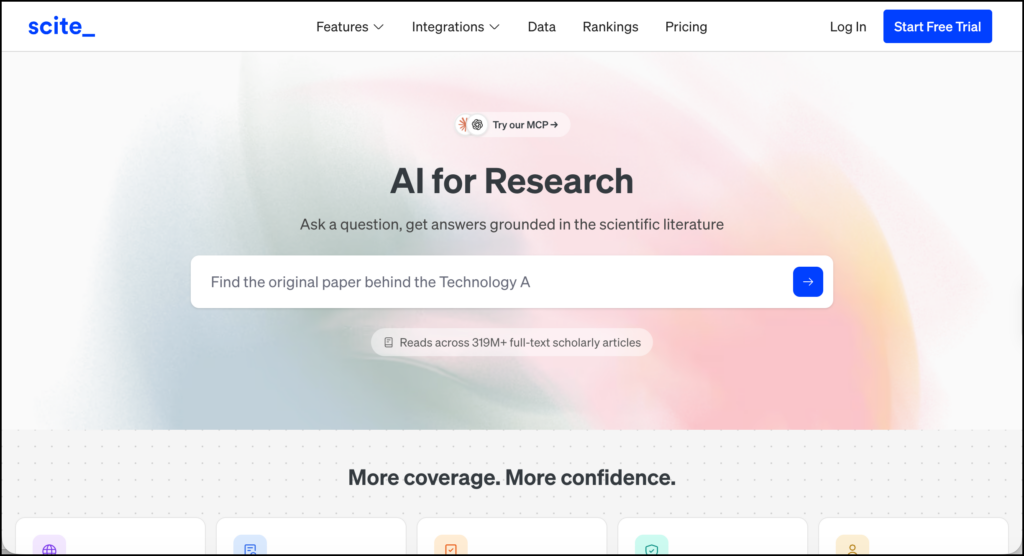
Main Scite Features
Smart Citations
Smart Citations are Scite’s defining feature. A standard citation count tells you how often a paper has been cited. A Smart Citation report provides the citation statements and assigns each one a classification.
The classification is useful for triage. If a paper has several contrasting citations, researchers can inspect those passages and the citing studies. However, the label should not be interpreted as a final verdict.
A contrasting citation may challenge one minor result while accepting the paper’s main argument. A supporting citation may repeat a claim without independently testing it. The surrounding paragraph, methods, and complete citing paper still need to be read.
Scite Reports
A Scite Report brings together the citations attached to a publication. Researchers can read the citation text and filter results by classification, publication year, section, and source type.
This can help answer questions such as:
- Has this finding been independently replicated?
- Have later researchers challenged the method?
- Is the paper mostly cited in introductions or results sections?
- Are newer studies reaching different conclusions?
- Has the publication received a retraction or editorial notice?
Reports are available for papers in the Scite index, but their completeness depends on the citation statements that Scite has been able to extract.
Scite Assistant
Scite Assistant accepts questions in natural language and generates responses linked to academic sources. It can be used for topic exploration, literature discovery, claim checking, and developing an initial reference list.
For example, a researcher might ask:
What evidence supports or challenges the claim that automated feedback improves student revision quality?
The answer can point toward relevant studies, but the generated synthesis still needs to be checked. Researchers should open the cited papers, verify that they support the associated statements, and distinguish empirical findings from interpretation.
Scite says Assistant draws from its large collection of academic sources, including paywalled material made available for indexing through publisher agreements. Access to a citation statement or generated answer does not necessarily provide access to the full paper.
Full-text citation search
Scite Search can search citation statements extracted from full texts. This allows researchers to locate findings, methods, and scholarly discussions that may not appear in article titles or abstracts.
Search results can be filtered by section, citation classification, journal, publication year, and other criteria. Searches can also support citation chaining and alerts.
This is useful when looking for how a particular claim has been discussed. A conventional search might locate papers about retrieval practice. A citation-statement search can help find passages discussing whether its effects transfer to new contexts.
Reference Check
Reference Check allows an author, editor, or reviewer to upload a manuscript PDF and examine the cited sources. It can flag references associated with retractions, editorial notices, or contrasting citation statements.
This can be valuable before submitting an article or thesis. A reference may have been reliable when first added but later corrected or retracted. Another source may be cited as support even though subsequent research has questioned its findings.
Reference Check does not verify that every citation has been interpreted accurately within the uploaded manuscript. The author still needs to compare each important claim with the original source.
Collections and alerts
Researchers can create collections from Scite search results or import papers from Zotero, Mendeley, or a CSV containing DOIs.
Collections monitor how papers are cited over time. They can notify users about new supporting or contrasting citations, retractions, and related developments. The Basic plan supports collections containing up to 1,000 papers, while Pro raises the limit to 10,000.
This is useful for following a dissertation topic, monitoring a set of included studies, or tracking what happens to a published article after release.
Browser extension and Zotero plugin
The free browser extension adds Scite badges to supported scholarly pages and search environments. It can show citation information while researchers browse resources such as Google Scholar and PubMed.
The extension also allows users to highlight a phrase on a webpage and send it to Scite Assistant for research-based exploration.
A Zotero plugin brings citation information into the reference-management workflow. This can help researchers notice retractions or contrasting citations without manually searching every paper in Scite.
API and MCP access
The Pro plan includes API access for programmatic use. Scite also provides an MCP connection that allows compatible AI applications and agents to retrieve information from its research index.
These features are more relevant to research teams, developers, librarians, and organizations creating specialized workflows. The free Connect plan includes a limited number of monthly MCP credits but does not include Scite Assistant or Search access.
How to Use Scite for Research
Scite is most useful when its citation data is connected to a defined research question. The following workflow uses it for discovery, evidence evaluation, and reference checking.
1. Begin with a focused research claim
Frame the topic as a question or provisional claim. For example:
AI-generated feedback improves revision quality among undergraduate second-language writers.
Break the claim into parts:
- AI-generated feedback
- Revision quality
- Undergraduate students
- Second-language writing
This provides a clearer basis for searching and evaluating evidence than a broad topic such as “AI in writing.”
2. Use Assistant for initial orientation
Ask Scite Assistant a neutral question:
What research has examined the effects of AI-generated feedback on revision quality among undergraduate second-language writers?
Avoid asking a leading question that assumes the effect exists. Follow up with prompts such as:
- What findings challenge this conclusion?
- Which studies used experimental designs?
- What measures were used to assess revision quality?
- Are the findings different across educational contexts?
- Which recent reviews address this question?
Save the relevant citations, but treat the answer as a map into the literature. Do not quote the generated synthesis as evidence.
3. Run a full-text citation search
Search for phrases that researchers may use when discussing the claim:
- “automated feedback” AND revision
- “AI-generated feedback” AND writing
- “automated writing evaluation” AND uptake
- “corrective feedback” AND second-language writing
Citation-statement searching may locate discussions buried in literature reviews, results sections, and limitations sections.
Use filters deliberately. A results-section citation may be more useful for evidence comparison than a passing mention in an introduction. A contrasting citation may reveal methodological criticism that a keyword search would not make visible.
4. Build a varied candidate collection
Create a collection for the project and add:
- Foundational papers
- Recent empirical studies
- Systematic or scoping reviews
- Studies reporting positive findings
- Studies reporting null or negative findings
- Relevant methodological papers
Import an existing Zotero or Mendeley collection if one already exists. Scite should add citation intelligence to the research library, not become an isolated pile of references.
Record why each paper was added. A note such as “contrasting result in first-year EFL course” will be useful during later synthesis.
5. Open the Smart Citation report for each central paper
For each paper likely to influence the review, inspect:
- Total citation statements
- Supporting citations
- Contrasting citations
- Mentioning citations
- Publication dates of the citing studies
- Sections where the citations occur
Do not compare papers only by the coloured totals. Open the actual statements.
A paper with five contrasting citations may have attracted substantive criticism, or the disagreements may concern only one measure. A paper with twenty supporting citations may be repeatedly cited by reviews rather than independently replicated.
6. Trace important citation statements to their sources
When a citation statement appears important:
- Open the citing paper.
- Locate the passage in context.
- Identify the precise claim being discussed.
- Examine the citing study’s methods.
- Check whether it supplies new evidence or only commentary.
- Record what part of the earlier paper it supports or disputes.
This avoids treating Scite’s classification as a replacement for reading. Automated labels are useful pointers, but scholarly disagreement is often too complicated for a three-part classification.
7. Create an evidence-evaluation table
Record the citation information alongside methodological details:
| Evidence field | What to record |
|---|---|
| Study | Full citation and DOI |
| Design | Experimental, observational, qualitative, review, or other |
| Population | Sample, context, and relevant characteristics |
| Claim examined | The precise finding relevant to the review |
| Scite pattern | Supporting, contrasting, and mentioning citations |
| Important citing studies | Papers requiring closer examination |
| Retraction or notice | Any correction, expression of concern, or retraction |
| Methodological concerns | Limitations found through full-text reading |
| Verification status | Unchecked, partially checked, or confirmed |
This keeps citation context and evidence quality separate. A citation pattern can guide appraisal, but the research design determines how much confidence the evidence deserves.
8. Search deliberately for disagreement
Literature reviews become weak when they collect only evidence supporting the expected conclusion.
Use contrasting filters and neutral searches to locate:
- Failed replications
- Studies reporting no effect
- Critiques of widely used measures
- Population-specific differences
- Methodological objections
- Alternative explanations
For the example topic, improvements in revision quality might appear only when students receive training in using automated feedback. Studies without that support may report different results. This distinction is more informative than counting how many citations are green or blue.
9. Evaluate reviews and foundational sources differently
For a systematic review, inspect which studies it includes, its search dates, and its quality-appraisal method. Supporting citations to the review do not validate every study inside it.
For a foundational theory paper, a high number of mentioning citations may simply show that the concept has become standard vocabulary. It does not demonstrate empirical support.
Interpret the citation pattern according to the type and purpose of the publication.
10. Use Collections to monitor the evidence
Enable alerts for the most important collection. New contrasting or supporting citations can matter during a long research project.
Before submitting a thesis, article, or report:
- Check for new citations
- Review retraction or correction notices
- Rerun the main searches
- Update the evidence matrix
- Reconsider any claim that depends heavily on one study
Monitoring is particularly useful when working in a fast-moving area where the evidence may change between the first search and final submission.
11. Run Reference Check before submission
Upload the manuscript PDF and review the results.
Prioritize:
- Retracted references
- Editorial notices
- Papers with substantial contrasting citations
- Sources supporting central claims
- Older references that may have been superseded
- Citations you have not recently verified
Then return to the manuscript and confirm that each important reference is used fairly. A source may be reliable yet still fail to support the sentence attached to it.
12. Preserve an audit trail
Export or record:
- Search terms
- Filters
- Search dates
- Collection contents
- Key citation statements
- Retraction checks
- Reasons for including or excluding studies
- Changes made after Reference Check
For formal reviews, Scite should be reported as an additional citation-context and discovery source. It does not replace reproducible searches in discipline-specific databases.
Scite Pricing
As of September 2026, Scite lists three individual options:
| Plan | Price | Main access |
|---|---|---|
| Connect | Free | 25 MCP credits per month; no Scite Assistant or Search access |
| Basic | US$20/month, billed annually | Assistant, Search, Smart Citation reports, collections up to 1,000 papers, alerts and dashboards |
| Pro | US$50/month, billed annually | Basic features, API access, 2,500 MCP credits, collections up to 10,000 papers, and patent, clinical-trial, and grant datasets |
| Team and Enterprise | Custom | Organizational licensing, administration, and expanded access |
Basic and Pro include a seven-day trial. The pricing page states that users are automatically enrolled in the selected subscription after the trial unless they cancel beforehand. Scite also describes a discount process for students and academics who recommend an institutional purchase.
Scite Compared with Other Research Tools
| Tool | Best use | Main strength | Important limitation |
|---|---|---|---|
| Scite | Evaluating how papers and claims have been cited | Shows citation context and supporting or contrasting statements | Automated classifications require interpretation |
| Elicit | Screening and extracting evidence | Creates structured study-comparison tables | Less focused on post-publication citation context |
| Consensus | Getting concise answers from published research | Accessible evidence-oriented question answering | Offers less detailed citation-statement analysis |
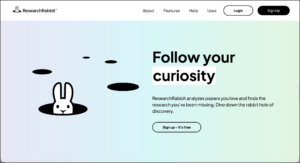
| ResearchRabbit | Discovering related papers visually | Maps citation and author relationships | Does not evaluate citation statements |
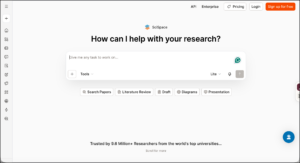
| SciSpace | Reading and extracting information from PDFs | Combines PDF analysis, data extraction, and writing tools | Generated answers still need source verification |
Scite fits best at the point where discovery meets evaluation. It can show how a paper has been received, while Elicit or a spreadsheet is better suited to extracting comparable study data.
Privacy, Academic Integrity, and Limitations
Scite’s privacy policy states that it collects account details, device and usage information, professional information, communications, and user-generated content. Most operations are conducted in the United States, and personal information may be processed there. The policy also describes analytics and advertising cookies, along with opt-out rights.
Researchers should avoid uploading confidential manuscripts, identifiable participant data, or unpublished work belonging to someone else unless they have permission and institutional approval.
Smart Citation labels are automated classifications. They can misread hedged language, methodological nuance, or a citation covering several claims. Their absence is also inconclusive: Scite may not have the necessary full text.
Academic integrity concerns arise when Assistant output is copied into a paper without verification or disclosure. Researchers remain responsible for every claim, citation, and interpretation in their work.
Final Assessment
Scite is most useful when a researcher needs to know how a paper has been cited, not merely how often. Smart Citations, full-text citation searching, collections, and Reference Check can expose disagreement, retractions, and later developments that ordinary citation counts conceal.
The classifications should be treated as signals for closer reading. They do not measure study quality, settle scholarly debates, or establish that a claim is true.
I would use Scite to evaluate central sources, search for conflicting evidence, monitor important papers, and check a manuscript before submission. Database searching, full-text reading, methodological appraisal, and scholarly judgment still carry the main evidential burden.
Sources
- Scite official website
- Scite features
- Scite pricing
- Scite Assistant
- Scite Search
- Scite data coverage
- Scite browser extension
- Scite privacy policy
- Scite terms of service