Sometimes the hardest part of reading a research paper is a single passage. An unfamiliar term, a compressed explanation, or a mathematical expression can interrupt our understanding of everything that follows. In this Explainpaper review, I look at a tool designed to help readers work through those difficulties.
What interests me is its focus on the text we are reading. We can begin with a specific passage, seek an explanation, and return to the authors’ wording to check our understanding.
What Is Explainpaper?
Explainpaper is an AI research-reading tool that lets users upload papers, highlight confusing text, and receive explanations. It is intended for readers working through academic material, including researchers, students, and educators.
The platform also offers paper chat, summaries, and saved highlights through its paid plan. I would place it in the research reading and summarization category: its main purpose is helping us engage with papers we already have.
Explainpaper Review: Features That Matter
Explain difficult passages
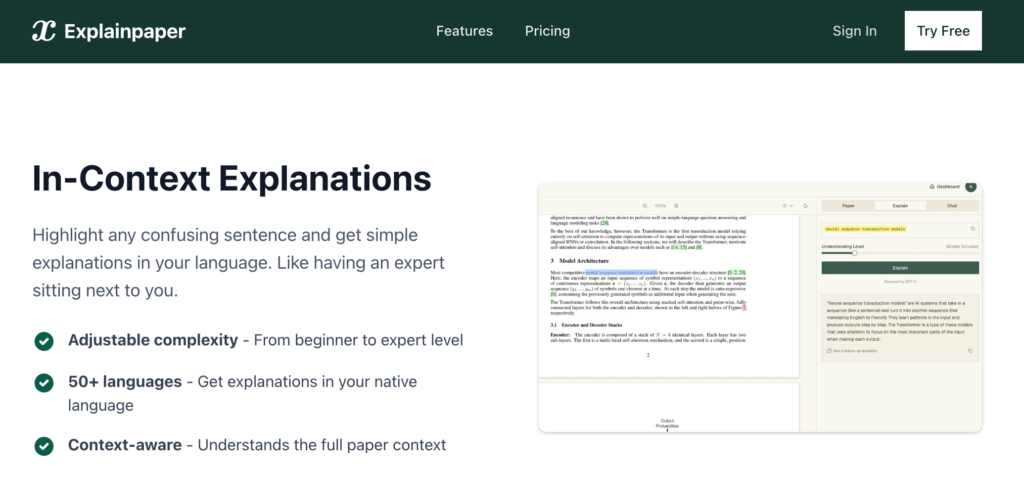
Explainpaper’s central feature is straightforward: select a confusing passage and request an explanation. Its website describes explanations that take the paper’s context into account.
This could be useful when reading outside your main area of expertise. You might understand the research question but struggle with terminology in the methods section. A passage-level explanation gives you somewhere to begin.
I would use it selectively. After receiving an explanation, reread the original passage and ask whether it now makes sense. If the explanation introduces a claim you cannot locate in the paper, investigate that claim before adding it to your notes.
Adjust the explanation level and language
The website advertises adjustable complexity, from beginner to expert, and explanations in more than 50 languages.
For multilingual readers, an explanation in a familiar language could provide another route into a difficult concept. I would still keep the original terminology visible, particularly when preparing to discuss or cite the paper in its publication language.
A simpler explanation also needs checking. Technical distinctions may matter even when they make a passage harder to read. The objective should be to understand those distinctions well enough to explain them accurately.
Ask follow-up questions
Follow-up questions allow readers to explore an explanation further. The free plan includes this function, while broader questions about a paper are listed under Pro.
For example, after requesting an explanation of a methods passage, you might ask what a particular term means in that context. I would keep the question tied to the difficulty that prompted it.
Questions about whether a method is appropriate require more than a fluent answer. Read the relevant sections and consider the study’s research question, evidence, and limitations yourself.
Use summaries and paper chat
Pro includes whole-paper summaries and questions about the paper. The website also describes outlines, key-point extraction, and navigation to relevant sections.
I would use a summary to identify where to read more closely. Check how it represents the purpose, methods, findings, and limitations before relying on it in a literature-review note.
Paper chat can serve a similar purpose. Ask a bounded question, locate the relevant section, and examine what the authors actually say. An answer may help you find the evidence; evaluating that evidence remains part of reading.
Work with formulas, figures, and saved explanations
The official pricing page lists Math Explain for formulas and figures, along with saved highlights and explanations, as Pro features. It also lists Zotero library importing on the free plan.
These features could help readers keep track of recurring difficulties. I would save an explanation alongside my own note about what I understood and what still needs checking.
For formulas and figures, compare the explanation with the original notation, labels, caption, and surrounding discussion. A readable interpretation can still overlook a condition or confuse a relationship.
Related: Adobe Acrobat AI Assistant Review
Features at a Glance
| Feature | Access listed on the pricing page |
|---|---|
| Highlight explanations | Free |
| Follow-up questions | Free |
| Zotero library import | Free |
| Whole-paper summaries | Pro |
| Questions about the paper | Pro |
| Saved highlights and explanations | Pro |
| Math Explain for formulas and figures | Pro |
| Team management and priority support | Teams |
Ways Researchers Can Use Explainpaper
Work through an unfamiliar methods section. Select the passage causing difficulty, request an explanation, and compare it with the original. Record unresolved questions for further reading.
Develop a terminology notebook. Keep the authors’ term, its meaning in the paper, and your own explanation together. Distinguish the tool’s wording from your interpretation.
Prepare for a reading-group discussion. Identify a passage you found difficult and explain how your understanding changed after using the tool. Bring remaining uncertainties to the group.
Check your initial understanding. Write a brief interpretation before requesting an explanation. Compare the two and investigate differences instead of automatically accepting the AI response.
These are suggested reading routines. The presence of an explanation feature does not establish that it improves comprehension or research quality.
Ways Teachers Can Use Explainpaper
I see a useful role in teaching students to examine explanations critically. Students could read a short passage, write what they think it means, and then compare their interpretation with Explainpaper’s response.
Ask them to identify which part of the response helped, whether it preserved the authors’ meaning, and what they would need to verify. This keeps attention on the relationship between an explanation and its source.
Another activity could focus on technical vocabulary. Students select one term, examine its use in the paper, and explain why an everyday-language substitute captures, or misses, its meaning.
For teacher-led demonstrations, choose a published paper appropriate to the class and show the original passage alongside the explanation. Students should be able to see what changed.
Is Explainpaper Free?
Checked on October 1, 2026, Explainpaper offers Free, Pro, and Teams plans. The free plan provides highlight explanations, follow-up questions, and Zotero importing.
Pro is displayed at $16 per month, and the pricing page offers a yearly option advertising a 25% saving. It also advertises a seven-day Pro trial; the homepage says that trial requires a card on file. Confirm the billing currency, renewal amount, and selected billing period before subscribing.
Teams pricing is available by contacting the company.
What to Keep in Mind
Explainpaper’s claim that users can read research “10x faster” is a marketing claim. I would not treat it as evidence that readers understand papers better or evaluate them more accurately.
A clear explanation can also feel convincing before it has been checked. Return to the source, especially when working with qualifications, statistical reasoning, and distinctions between association and causation.
For unpublished manuscripts, confidential material, or student work, confirm the applicable data-handling terms and institutional requirements before uploading. The feature and pricing pages reviewed here do not establish how those materials would be handled.
My Assessment
Explainpaper is worth considering if your main difficulty is understanding particular passages in academic papers. Its free highlight explanations provide a practical starting point, while Pro adds functions for summaries and broader paper interaction.
I would begin with a paper you know reasonably well. Select several difficult passages and assess whether the explanations preserve their meaning. Then try an unfamiliar paper, keeping the same habit of returning to the original text.
The most useful outcome is being able to explain the passage accurately yourself after using the tool.