“To enhance reading comprehension, you need to read.”
Someone shared this comment on the guide I published yesterday on my Facebook page, and I agree with it completely.
Reading, at its core, is a human cognitive act. Interpretation, sense-making, critique, and meaning construction sit at the heart of what it means to read. These are not mechanical operations that can simply be handed over to a tool. They require attention, judgment, prior knowledge, and lived experience.
At the same time, this does not mean that reading must happen today exactly as it did centuries ago.
Throughout history, humans have created technologies to extend their capabilities. Early tools amplified physical labor. Later inventions supported memory, calculation, communication, and analysis. Today, AI enters this long lineage as a technology that extends cognitive work.
I often return to the way Marshall McLuhan described media as extensions of human capacities. From this perspective, AI does not replace thinking. It extends it, provided it is used with intention and restraint.
This distinction matters. The danger is not AI itself, but allowing AI to displace the very cognitive work that makes reading meaningful.
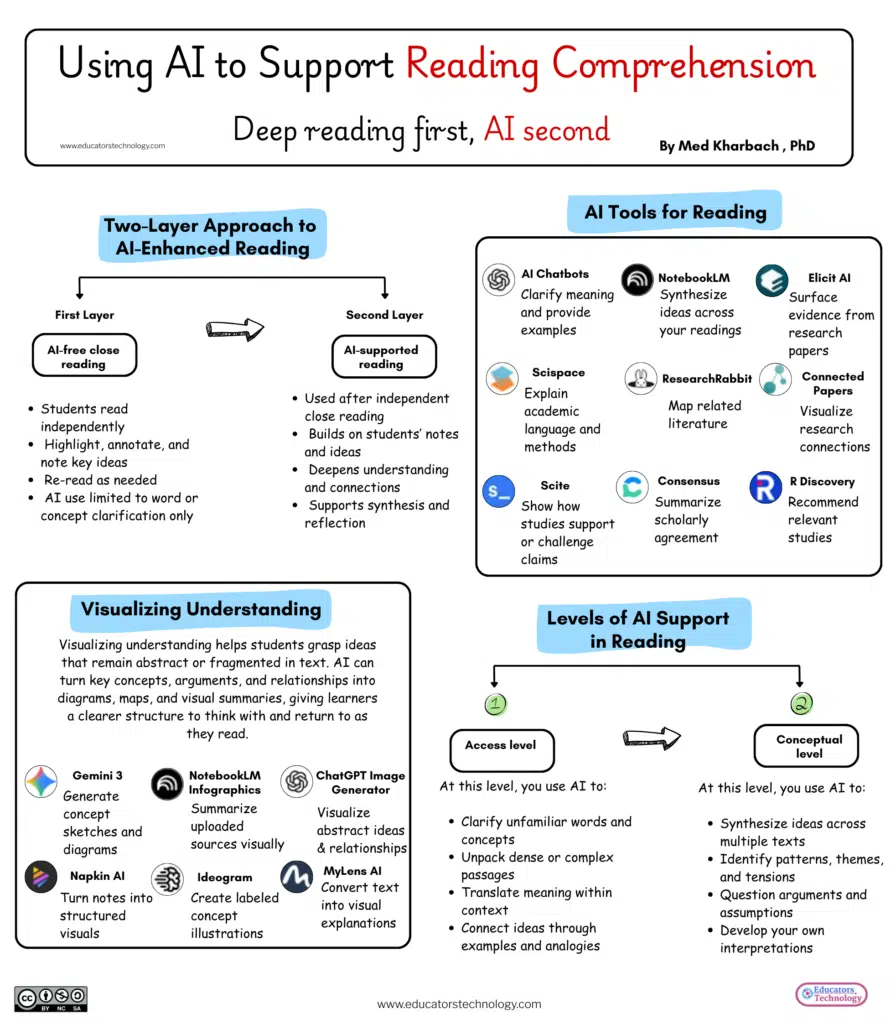
Based on my own sustained use of AI, along with workshops, classroom discussions, and ongoing conversations with teachers and researchers, I developed a simple two-layer framework for using AI to support reading comprehension.
The first layer keeps reading fully human.
In this layer, students read on their own. They annotate, highlight, reread difficult passages, and wrestle with ideas directly from the text. AI is absent or used minimally, perhaps as a dictionary to clarify unfamiliar terms or concepts. The goal here is deliberate engagement with the text itself.
This layer protects the cognitive friction that builds comprehension. Struggle is not a flaw in reading. It is part of how understanding develops.
The second layer introduces AI strategically.
This is the conceptual layer, where readers deepen understanding after an initial reading has already taken place. Here, AI can support synthesis, comparison, reflection, and connection making. Students might use AI to surface alternative interpretations, test their understanding, or connect ideas across texts, always with the reader retaining control over judgment and meaning.
In this layer, AI supports thinking without replacing it.
What matters is sequence. Reading comes first. AI comes after.
I shared a detailed guide on this two-layer approach yesterday titled AI-based Strategies to Enhance Reading Comprehension. I also created a visual that summarizes the core ideas in a way that works well for professional development sessions, workshops, or classroom discussion.
Reading still starts with reading. AI works best when it follows, not when it leads.
Reference
McLuhan, M. (1964). Understanding media: The extensions of man. McGraw-Hill.