“I used AI” tells a teacher very little about how an assignment was completed. A student might have used a chatbot to brainstorm a topic, explain an unfamiliar term, rewrite a paragraph, or generate code. Those contributions are different, and a useful disclosure makes the difference clear.
An AI disclosure statement explains which tools a student used, what they used them for, and how the output contributed to the submitted work. Depending on the assignment, students may also need to identify specific sections, provide prompts and outputs, or explain how they checked the material.
Below are examples students can adapt and teachers can use when discussing transparent AI use. These are original teaching examples, not official institutional templates. Use them only when they accurately describe what happened, and follow the assignment’s rules first. A disclosure does not make a prohibited use permissible.
AI Disclosure Examples at a Glance
| Type of use | What the statement should clarify |
|---|---|
| Brainstorming | How AI helped generate or narrow ideas |
| Planning | Whether AI suggested the structure or sequence |
| Concept explanations | What the student asked AI to explain |
| Grammar and proofreading | Which kinds of changes were suggested and retained |
| Substantial rewriting | Where AI-generated wording remains |
| Research discovery | How AI helped locate possible sources and what was checked |
| Translation | Which material was translated and how it was used |
| Coding | Which code AI generated, revised, or helped debug |
| Images and presentation materials | Which visual or slide elements involved AI |
| No AI use | A truthful declaration when the assignment requests one |
What Should an AI Disclosure Statement Include?
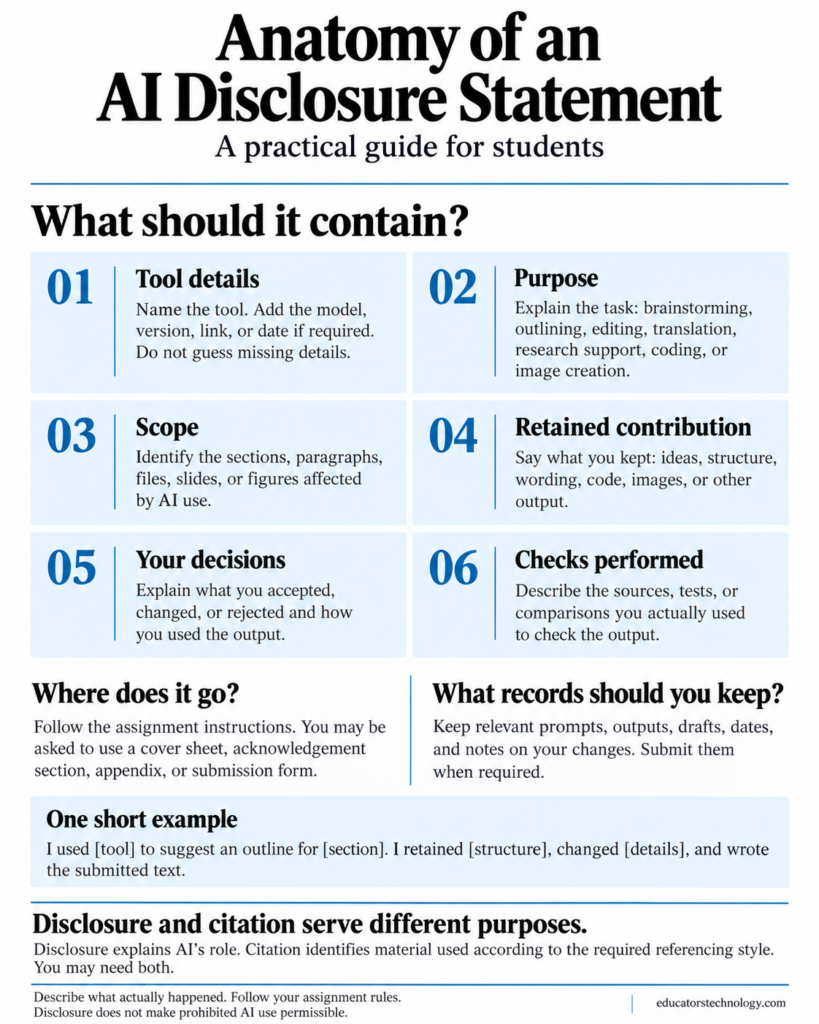
A practical statement usually answers four questions:
- Which tool did you use? Give the product name and any additional details required by your instructor.
- What did you use it for? Name the actual task.
- What contribution remains? Identify retained wording, ideas, code, images, or structural suggestions.
- What did you do with the output? Explain relevant checking, changes, or decisions.
For example, Monash University asks students to document the type of AI used and its contribution, with acknowledgement requirements set for the assessment. Your instructor may require more detail than a short paragraph provides. Student Academic Success
Include dates, a tool URL, the displayed model or version, and records of interactions when required. If a model name is not available, do not guess it.
1. AI Used for Brainstorming
I used [tool name] to generate possible angles for an essay about [topic]. I selected [angle] and developed the argument through my reading. The tool influenced my choice of focus, but no generated sentences were included in the submission.
This distinguishes help with choosing a direction from help writing the essay. If AI also shaped the argument, describe that contribution.
2. AI Used to Develop an Outline
I used [tool name] to suggest an outline for my report on [topic]. I retained the sequence of [sections] and changed [specific part] to fit my argument. I wrote the submitted text using the sources cited in the report.
Planning is part of the process even when AI wording does not appear in the final text. A disclosure can explain that influence.
3. AI Used to Explain a Concept
I used [tool name] to explain [concept] and provide a worked example while preparing this assignment. I checked the explanation against [course material or source]. I then completed [task or section] using my own explanation.
Only include the checking sentence if that check occurred. If an AI example was adapted into the submission, identify it.
4. AI Used for Grammar and Proofreading
I used [tool name] to suggest corrections to grammar, spelling, and punctuation in my draft. I reviewed the suggestions and retained changes to [brief description]. I did not use its paragraph-rewriting or content-generation features.
Be accurate about the feature used. A tool may offer basic corrections and substantial rewriting within the same interface. Whether basic proofreading requires disclosure depends on the assignment and institutional guidance. For example, the University of Sydney distinguishes basic spelling and grammar corrections from uses requiring acknowledgement. sydney.edu.au
Related: Gemini Notebook Review: A Practical Guide for Researchers
5. AI Used for Substantial Rewriting
I used [tool name] to rewrite the first draft of [section or paragraphs] for clarity and organization. I edited the output, but some AI-generated wording remains in those sections. The ideas and sources I supplied were [brief description], and I checked the revised wording against them.
Use this only where that assistance is permitted. “Proofreading” would understate the contribution if the tool rewrote paragraphs.
6. AI Used to Find Possible Research Sources
I used [tool name] to suggest search terms and possible sources about [topic]. I searched for the suggested materials and consulted the sources cited in this assignment. I excluded [suggestion or source] because [reason, if relevant].
If AI also summarized papers or extracted information, disclose those activities separately. Claim to have read or verified a source only when you have done so. Cite the original sources you actually consulted using the required referencing style.
7. AI Used for Translation
I used [tool name] to translate my draft from [language] into English. I reviewed and edited the translation, including [specific terminology or changes]. The submitted English text therefore includes wording produced through AI translation.
If translation was used only to understand a source, describe that instead. Translating a student’s draft and translating background reading are different contributions.
8. AI Used for Coding
I used [tool name] to generate an initial version of [function or component] and suggest a fix for [error]. The submitted code includes an adapted version of that output in [file or lines]. I changed [specific features] and tested it using [actual tests].
Explain the scope precisely. Testing that code runs is different from establishing that it handles relevant cases correctly. Follow any requirements for comments, citations, or interaction logs.
9. AI Used for Images or Presentations
I used [tool name] to generate the illustration on slide [number] from a prompt describing [subject]. I selected the image and changed [details]. I created the remaining slide content using [materials or process].
If AI also generated the slide text, outline, or speaker notes, include that contribution. For multiple images, a figure-level acknowledgement or accompanying table may be clearer, subject to the assignment instructions.
10. No AI Used
I did not use generative AI to plan, draft, revise, translate, or create content for this assignment.
Use a statement with this scope only if it is true and fits the requested declaration. If you used a permitted AI feature, describe it. Some assignments require a declaration from every student, including those who did not use AI. Student Academic Success
A Flexible AI Disclosure Template
AI use disclosure: I used [tool name, plus required version or date information] for [specific purpose]. Its contribution affected [sections or components]. I retained [contribution], changed [details], and checked [material] against [reference or test]. [Prompts, outputs, or other records] are provided in [location], as required.
Delete or revise any part that does not apply. A short, specific account is more useful than a sweeping claim that everything was independently verified.
Where Should Students Put the Statement?
Follow the assignment instructions. Possible locations include a cover sheet, an acknowledgement section, an appendix, or a designated submission field. The University of Melbourne, for example, advises placing a declaration after the reference list, but this is not a universal rule. my.unimelb
Also distinguish disclosure from citation. Disclosure explains AI’s role in the process; citation follows the required style for material used in the work. An assignment may require both. AI Student Hub
For teachers, I would introduce the disclosure format when setting the task. Show students what information to retain as they work and what a sufficiently specific explanation looks like. That makes disclosure part of documenting their decisions, rather than something they have to reconstruct at submission time.