A tenth grader closes the laptop at 11 PM. The essay is done. ChatGPT helped with the outline, the opening, and a couple of transitions. The student wrote some of the body, edited the rest, and isn’t entirely sure where the line is. Neither is the teacher who’ll grade it. That gap is where the middle and high school AI Use Agreement comes in.
This is the second of three companion posts I’m publishing on AI Use Agreements for different grade bands. The elementary post covers K-5. This one covers Grades 6-12.
What’s Inside the AI Use Agreement
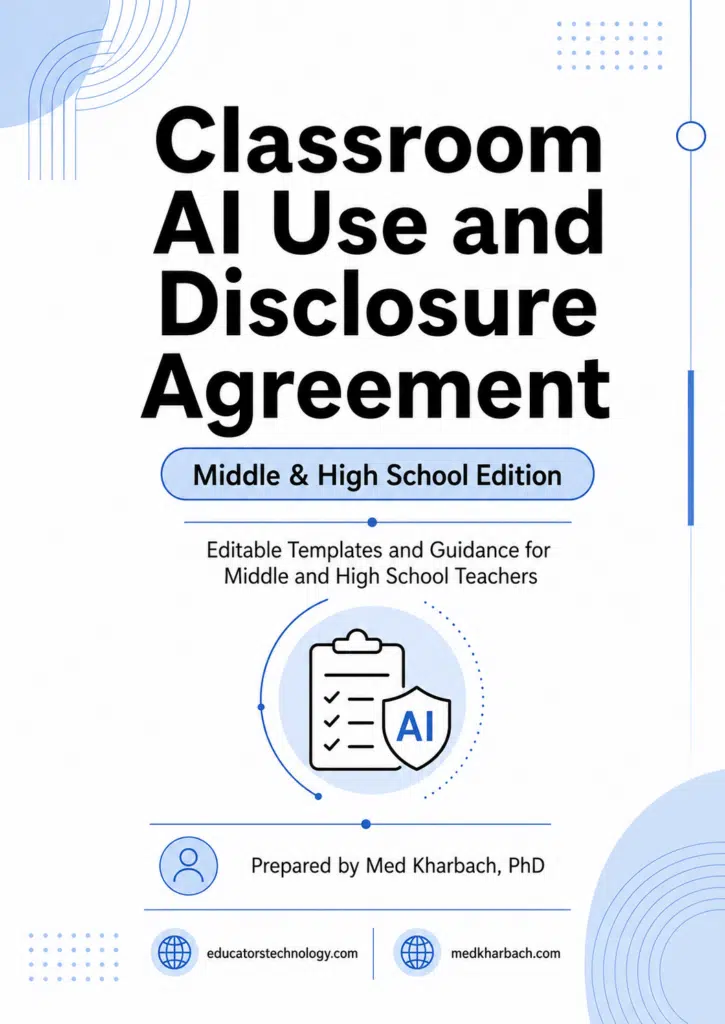
The document is fully editable in Word and is designed for adaptation to your school context.
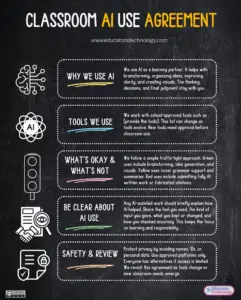
The big design shift from the elementary edition is the increased autonomy assumed for students. By middle and high school, most students are doing their own AI work outside of class, often without much oversight. The agreement reflects that reality.
The first page is a teacher guidance section. It includes an editable approved-tools list for your school or district, a full reference table for the four AI use levels (Level 0: No AI; Level 1: AI for Planning; Level 2: AI for Feedback; Level 3: AI-Assisted Creation), and an editable subject-specific examples table covering English, Math, Science, History, World Languages, Computer Science, and the Arts.
The student-facing AI agreement follows. It covers the AI use levels with student-language examples, what’s acceptable and not acceptable, how to disclose AI use, privacy and safety expectations, accuracy and verification, academic integrity, equity and access, responsible communication, and a student signature line.
There’s also an AI Use Disclosure Form (one page, designed to be photocopied or pasted into Google Classroom), a one-page AI Use Quick Guide for student binders, and an optional family note for sending home.
Why the Choices Matter
A few design decisions in this edition deserve attention.
First, the move to a four-level scale. The elementary edition works with three simple levels. Middle and high school assignments are varied enough that students need more granularity. Level 0 (No AI) is for in-class essays and tests. Level 1 (AI for Planning) lets students brainstorm and outline. Level 2 (AI for Feedback) lets AI critique drafts. Level 3 (AI-Assisted Creation) is for assignments where AI is part of the design itself. Teachers assign a level per assignment.
The disclosure form is the piece I’m most attached to in this edition. Students fill out a short form whenever AI was used: tool, what they asked it, what parts of the work AI helped with, what they changed or verified, and how they made the final work their own. The form is editable and built to be dropped into Google Classroom or printed.
Finally, the student signature. At this age, signing a course-level agreement is a small but real moment of accountability. It moves the agreement from a poster on the wall to something the student has committed to.
How to Use It
Treat the document as a starting frame. Edit the four-level scale to match your subject. Update the approved-tools list. Add your school’s academic integrity code reference. The disclosure form can be photocopied as-is or rebuilt as a Google Form. The quick guide is designed to be one page; print and post.
Subject teachers will find different parts more relevant. English departments tend to focus on the levels and the disclosure form. Math classes often skip the disclosure form entirely (most math problems are Level 0). For science teachers, the document fits naturally onto lab reports and research projects. Whatever subject you teach, the document should adapt to your assessment rhythm, not the other way around.
Most teachers find the disclosure form worth piloting first. Once students get used to filling it out for one assignment, it becomes routine across the term.
Companion Editions
This is one of three editions I built. The Elementary edition (K-5) takes a different approach with a simplified three-level system: [Elementary Edition – link to add]. The Higher Education edition (undergraduate and graduate courses) uses the full five-category Perkins, Roe, and Furze AI Assessment Scale. There’s also a Master Document that combines all three editions: [Master Document – link to add].
Download the Middle and High School Edition
The full editable Word document is here: https://www.educatorstechnology.com/wp-content/uploads/2026/05/AI-Use-Agreement-Middle-High-School-Edition.docx
The work is shared under a Creative Commons license. Use it, adapt it, share it with colleagues. If you make changes that work well in your context, I’d love to hear about them.