AI in elementary classrooms looks nothing like AI in high school. Most K-5 students aren’t old enough to have their own ChatGPT or Claude accounts. Teachers are doing most of the AI work themselves, on the smartboard or behind the scenes when prepping materials. Families are watching closely, and they want to know what’s happening. That’s why a one-size-fits-all AI policy doesn’t work in elementary, and why I built a separate AI Use Agreement specifically for K-5 teachers.
This post walks through the elementary edition. It’s the first of three companion posts on AI Use Agreements I’ve put together for different grade bands.
What’s Inside the AI Use Agreement
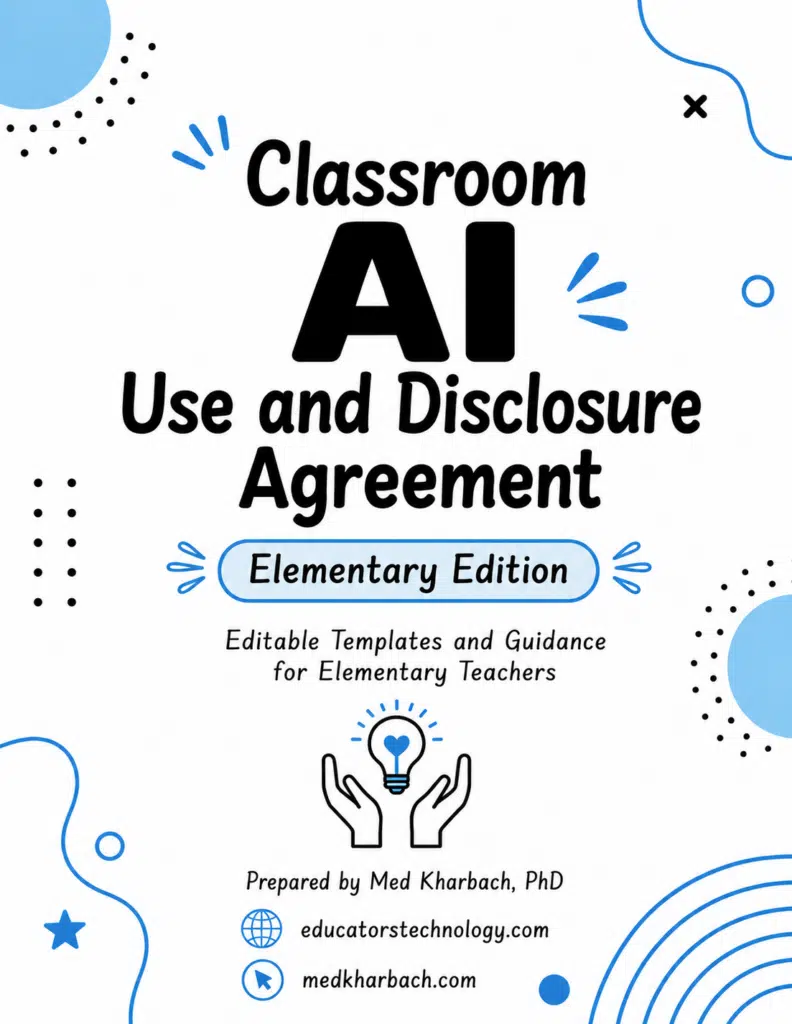
The document is six pages, all editable in Word, and designed to be adapted to your specific classroom, district, and school context.
The first page is a teacher guidance section. It covers age-appropriate AI use (most public AI tools have age restrictions, and most elementary students aren’t using them independently), a list of common teacher uses of AI (lesson planning, differentiation, generating reading passages, creating visuals), an editable approved-tools list for your school, an “AI Is Not a Person” note teachers can share with younger students, and a quick tool review checklist for evaluating new AI products.
The next two pages are the student-facing AI agreement. The core is a simple three-level system: Stop (AI cannot do this for me), Ask First (the teacher decides), and Use Together (the class explores AI as a group). Three levels are enough for K-5 children. Perkins-style four or five-level scales work better for older students.
The agreement also includes six “Good AI Habits” I want students to internalize: ask before using, keep private things private, use my own thinking first, check answers, tell the teacher how AI helped, fix mistakes.
There’s also a one-page AI Use Reflection Card students complete after using AI, a family note teachers can adapt and send home, and a one-page classroom poster (“Our 5 AI Rules”) for classroom walls.
Why the Choices Matter
A few decisions in this edition deserve a quick explanation.
First, the “AI Is Not a Person” framing. Young children anthropomorphize AI quickly. They talk to it like a friend. That’s a real concern for AI literacy at this age, and the agreement names it directly.
The simplified three-level system is the second deliberate choice. The full Perkins, Roe, and Furze AI Assessment Scale has five categories. That’s the right tool for high school and higher ed. For K-5, three levels are easier to remember and match the kinds of decisions teachers actually make: AI off, AI maybe (with permission), AI together.
Finally, the family note matters here in a way it doesn’t at older grade bands. Elementary parents stay closely involved in their child’s classroom in a way high school parents often don’t. The note explains how AI is being used and confirms that students aren’t being asked to create personal accounts. That builds the kind of trust that makes the rest of the year easier.
How to Use It
The document is intentionally editable. Take what works. Cut what doesn’t. Add your school’s approved tools list, your honor code reference, your contact email. The point isn’t to give every teacher the same agreement. The point is to give every teacher a starting frame so they don’t have to build one from scratch.
I’d recommend reading the agreement with your students in the early grades and talking through each section. Older elementary students can sign the class agreement at the bottom. It’s a small ritual but it works.
Companion Editions
This is one of three editions I built. There’s also a Middle and High School edition (Grades 6-12) and a Higher Education edition (undergraduate and graduate courses). Each one reflects the developmental realities of its grade band.
Download the Elementary Edition
The full editable Word document is here: https://medkharbach.com/wp-content/uploads/2026/05/AI-Agreement-Elementary.docx
The work is shared under a Creative Commons license. Use it, adapt it, share it with colleagues. If you adapt it in ways that work better for your specific context, I’d love to hear about it.