One of the areas where AI has triggered the most noise is assessment.
Now that AI can produce human-like text, complete assignments, and offer personalised support, many educators see this as an alarm bell.
If the purpose of assessment is to understand (evaluate) what students know, how they think, and what they can do, and AI can do much of this on their behalf, then what exactly are we assessing?
That concern is often amplified online, sometimes by people who already distrust AI. Still, it is not an empty argument. AI has genuinely reshaped assessment practice.
The old approaches we relied on no longer hold in the same way. Pretending otherwise does not help students or teachers.
This is why assessment design needs a serious rethink. I am not talking here about chasing AI-proof tasks, good luck with that if you can.
I am talking about designing assessments that work alongside AI, make its use visible, and shift the focus toward judgement, process, decision-making, and learning over time.
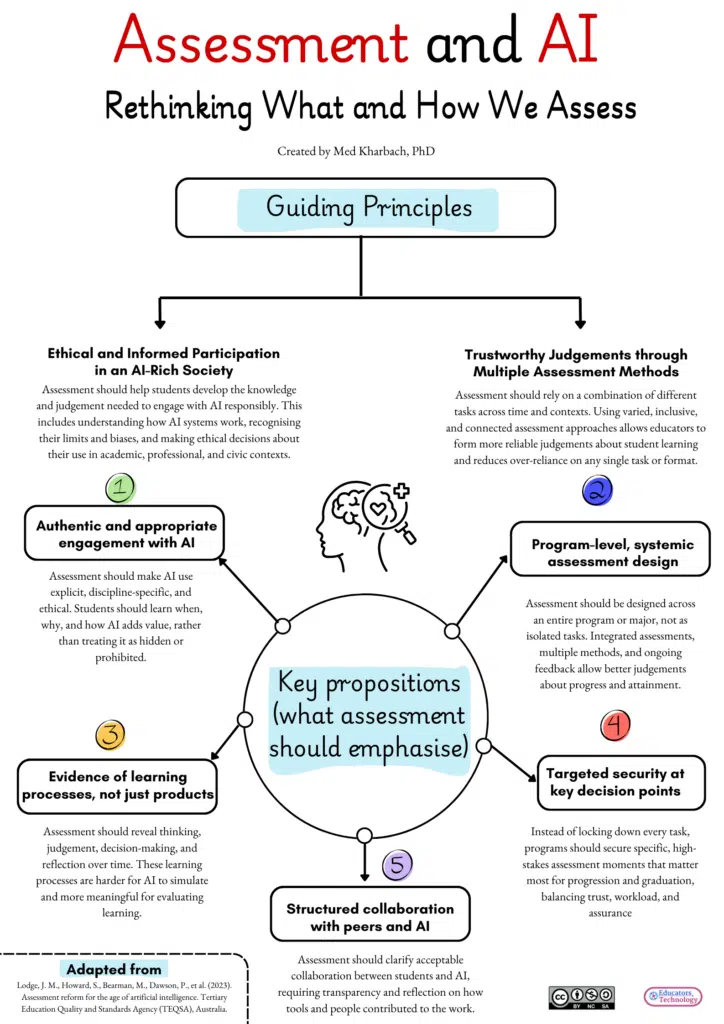
TEQSA’s 2023 guide on assessment in the age of AI speaks directly to this challenge.
It offers a clear framework built around two guiding principles and five propositions that help educators think beyond single tasks and toward systemic, program-level, and coherent assessment design.
I have summarised that framework and captured it in the visual attached.
Here is the reference if you want to read the entire guide:
Lodge, J. M., Howard, S., Bearman, M., Dawson, P., et al. (2023). Assessment reform for the age of artificial intelligence. Tertiary Education Quality and Standards Agency (TEQSA), Australia.
Related: Rethinking Assessment in the Age of AI