Google quietly rolled out one of the most useful updates to Classroom in years. If you haven’t explored Gemini in Google Classroom yet, here’s what you need to know and how to actually use it.
What Exactly Is Gemini in Classroom?
Gemini is Google’s AI assistant, now built directly into Google Classroom for all educators with Workspace for Education accounts. And yes, it’s free.
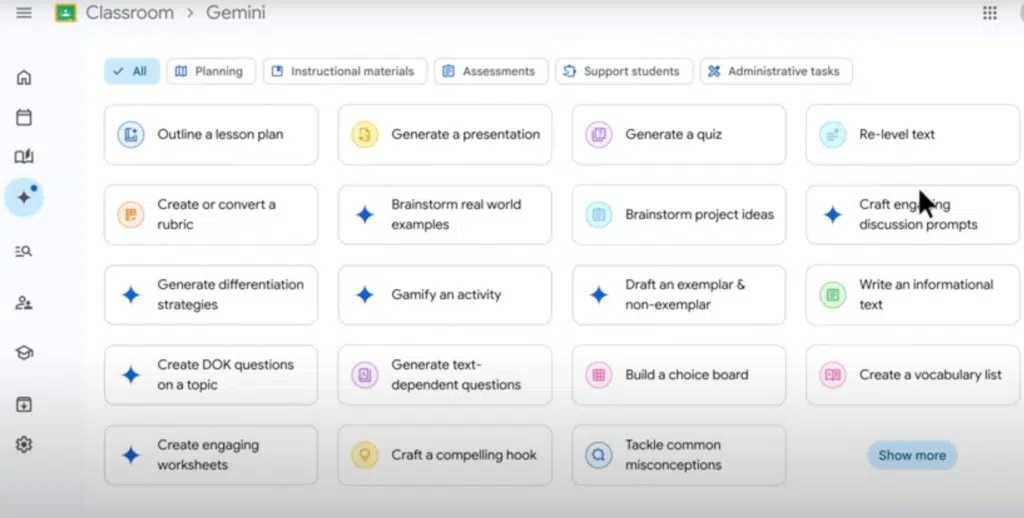
You’ll find it in your Classroom sidebar. Click the Gemini icon, and you’ll see a menu of tools designed specifically for teacher tasks: lesson plans, quizzes, rubrics, vocabulary lists, reading comprehension questions, differentiated assignments, and more. Google added over 30 of these AI-powered features, all focused on the stuff teachers actually create every week.
The important thing to remember: you’re still the teacher. Gemini generates drafts. You review, tweak, and decide what makes it to your students.
Finding Gemini in Your Classroom
Here’s the quick setup:
- Open Google Classroom
- Look for the Gemini icon in the left sidebar
- Click to open the AI tools panel
- Choose what you want to create
If you don’t see the icon, your admin may need to enable it. Gemini in Classroom currently works only in English and requires users to be 18 or older in your domain’s settings.
A Real Workflow: Planning a Week in 45 Minutes
Let me show you how this actually works in practice.
Say you’re a 7th grade science teacher starting a unit on ecosystems. Here’s how Gemini can help you prep for the whole week.
Start with your lesson plan. Select “Outline a lesson plan” and type something like: “Create a 5-day lesson plan for 7th grade life science on ecosystems and food webs. Include learning objectives aligned to NGSS MS-LS2, daily activities, and formative assessment ideas.”
You’ll get a draft in seconds. Scan it, adjust the pacing where needed, and you’ve got your roadmap.
Add a vocabulary list. Select that option and enter your terms: producer, consumer, decomposer, food chain, food web, trophic level. Gemini adds definitions and example sentences. You now have something ready for a handout, word wall, or Quizlet set.
Build your quiz. Ask for “a 10-question quiz on ecosystems for 7th grade with 6 multiple choice, 2 short answer, and 2 questions analyzing a food web diagram.” Gemini drafts it, and you can export directly to Google Forms.
Differentiate the reading. Paste your passage and ask Gemini to create a version at a 5th grade reading level. Then ask for challenge questions for your advanced learners.
Total time: about 45 minutes for a full week of materials. That same prep used to take 2-3 hours on a Sunday night.
Related: Using Gemini in Google Slides to Create Engaging Slides
Writing Prompts That Actually Work
The quality of what you get depends entirely on how you ask. Vague prompts give vague results.
Google suggests the PARTS framework:
- Persona: Who should Gemini act as? (“You are a 4th grade reading specialist…”)
- Act: What should it do? (“Create,” “Generate,” “Rewrite”)
- Recipient: Who is this for? (“…for English learners,” “…for parents”)
- Theme: What’s the topic?
- Structure: What format? (“…as a rubric with 4 levels”)
Here’s a strong example: “You are a 5th grade ELA teacher. Create 8 reading comprehension questions for a passage about the California Gold Rush. Include 3 about main idea, 3 about details, and 2 requiring inference. Format as a worksheet with space for written answers.”
Compare that to “make a worksheet about the Gold Rush.” See the difference?
The Conversation That Makes It Work
Here’s something most guides skip: your first prompt rarely produces exactly what you need. And that’s fine.
Gemini works like a conversation. After it generates something, you can follow up:
- “Make this shorter.”
- “Add more challenging questions.”
- “Include a real-world example from sports.”
- “Remove question 4 and add something about evaporation.”
This back-and-forth is where Gemini becomes genuinely useful. You’re collaborating with a tool that responds to your knowledge about your specific students.
Quick Wins by Subject Area
- Math teachers: Gemini generates solid word problems and error analysis activities. Just double-check the calculations. It occasionally makes mistakes.
- ELA teachers: Discussion questions, writing prompts, and vocabulary activities are strong areas. Ask for text-dependent questions that require evidence.
- Science teachers: Pre-lab worksheets, CER scaffolds, and safety protocols come together quickly. Great for lab prep.
- Social studies teachers: Background readings and primary source analysis questions save significant time, especially for DBQ prep.
Differentiation in Minutes
The differentiation tools might be where Gemini saves you the most time. You can create multiple versions of the same assignment without starting from scratch.
Try this prompt: “Create three versions of this assignment. Version A: simplified vocabulary, sentence starters, reduced to 3 paragraphs. Version B: grade level as written. Version C: add an extension question requiring synthesis.”
For IEP-aligned modifications: “Modify this for a student whose IEP includes extended time, reduced writing, and visual supports. Keep the learning goals but adjust format and length.”
You’ll get chunked instructions, fewer required responses, and suggestions for visual elements. Review it, adjust what needs adjusting, and you’ve saved yourself an hour of rewriting.
Student-Facing Tools: Gems and NotebookLM
You can also create AI experiences for students. These stay grounded in your materials, not the whole internet.
- Gems are custom AI assistants built from your class materials. You might create a “Quiz Me” Gem for vocabulary review or a “Study Partner” Gem for test prep. Students can chat with it and ask questions, but the AI only references what you’ve uploaded. It stays grounded in your content.
- NotebookLM works similarly. Upload your lecture notes or readings, and students get interactive study guides, podcast-style audio summaries, and flashcards based on your materials. Great for exam review or catch-up resources for absent students.
To create either one, go to Classwork, click Create, and look for Gem or NotebookLM under the Attach options.
What to Watch Out For
Gemini occasionally generates factual errors, especially in math and historical details. It sometimes misjudges grade level or includes generic examples that don’t fit your context.
Build a quick review habit. Scan everything before it reaches students. If something feels off, trust that instinct.
And remember: AI handles the drafting. You handle the relationships, the sensitive feedback, the moments when a student needs a person. Gemini can free up time for more of those moments. It shouldn’t replace them.