We keep talking about AI literacy, but teacher professional development around AI is still not getting the attention it deserves. There’s plenty of focus on tools and skills, but much less on how teachers actually learn to work with AI in thoughtful, confident ways. And the thing is, AI literacy only works if teachers themselves understand AI well enough to make good decisions with it. That understanding comes from ongoing professional development, not from one-off sessions or quick demos.
This is something I explore in depth in my book Teaching with AI, where I argue that meaningful AI integration starts with teachers building their own fluency first. Anthropic Academy offers a growing set of resources that align well with this approach.
I’ve been working through several of their courses in my own teaching and training sessions, and the focus is on helping educators implement AI more thoughtfully in their classrooms and curricula. If you’re looking for structured professional development that goes beyond surface-level tool training, these courses are worth your time.
Now, like Google for Education, Anthropic Academy does lean toward its own flagship tool, Claude. And to be fair, Claude is a strong choice for academic research and student work. But the strategies, frameworks, and practical insights these courses offer apply well beyond any single chatbot. You can take what you learn here and adapt it to whatever AI tools you and your students use.
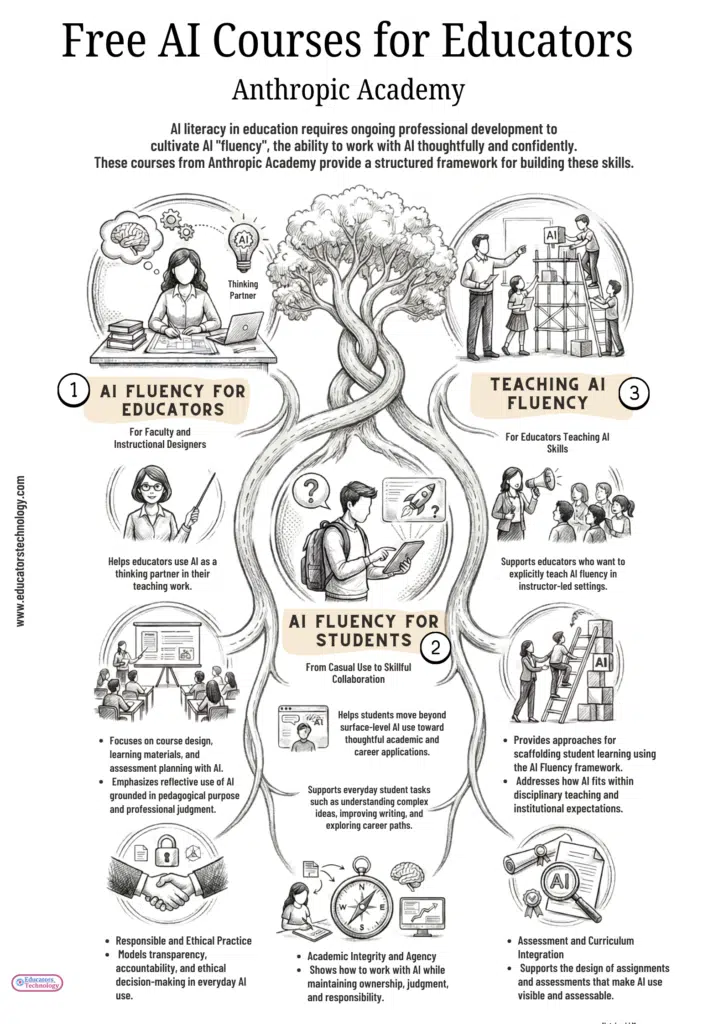
1. AI Fluency for Educators
AI Fluency for Educators is a concise, practice-focused course for faculty, instructional designers, and educational leaders. It centers on applying the 4D AI Fluency Framework directly to teaching work. The course shows how AI can support course design, learning materials, and assessment planning when treated as a thinking partner. Examples stay close to real classroom and curriculum decisions, with consistent attention to ethical use, transparency, and modeling responsible AI practices for students.
The course is built through long-term collaboration between Anthropic and experienced educators who have trained peers and taught AI fluency in higher education. It speaks to a familiar question many instructors ask: how do I apply this framework in my own courses? The lessons connect the four dimensions of AI Fluency to everyday teaching tasks, offering a clear structure educators can adapt to their own contexts and institutional expectations.
2. AI Fluency for Students
AI Fluency for Students is a short course designed to help students move from casual AI use to thoughtful, skillful collaboration. It introduces the 4D AI Fluency Framework and shows how students can work with AI to support learning, academic work, and early career planning.
The focus stays on everyday student tasks such as understanding complex ideas, improving writing, exploring career options, and organizing learning. AI is framed as a partner that supports thinking and growth, with clear attention to ethical use, safety, and personal responsibility.
The course speaks directly to questions students already ask themselves: how do I use AI without weakening my own thinking or crossing academic boundaries? Lessons connect the four dimensions of AI Fluency to real study and career scenarios, helping students keep agency and judgment front and center. By the end, students leave with a clearer sense of how to collaborate with AI in ways that strengthen learning, support long-term goals, and fit within academic integrity expectations.
3. Teaching AI Fluency
Teaching AI Fluency is designed for educators who want to move from using AI themselves to teaching it deliberately and assessing it well. The course focuses on how to scaffold student AI Fluency in instructor-led settings using the 4D Framework. It walks through practical teaching approaches that help students learn how to delegate tasks to AI, describe goals clearly, evaluate outputs critically, and take responsibility for decisions. The emphasis stays on teaching practice, with AI positioned as a thinking partner that supports learning without weakening disciplinary knowledge or academic standards.
The course also spends time on assessment and institutional context. It helps educators design assignments and assessments that make AI use visible and meaningful, so AI Fluency develops alongside subject expertise rather than outside it. Later sections address how AI intersects with different disciplines and how departments and institutions can build shared capacity around responsible AI use. This course fits educators who already teach or design curricula and want clear guidance on how to teach AI Fluency explicitly, assess it fairly, and align it with broader program and institutional goals.
Conclusion
I hope you found these resources helpful. If you’re looking to strengthen your own AI fluency or help your students develop theirs, these three courses offer a solid starting point. They won’t give you all the answers, but they will give you a clearer framework for thinking through how AI fits into your teaching practice. And remember, professional development around AI isn’t a one-time thing. It’s ongoing work. The more you engage with structured learning like this, the more confident and intentional you’ll become in the choices you make with AI in your classroom.