Not every teacher teaches just one grade band. School administrators, instructional coaches, professional development facilitators, parents thinking about their child’s AI use across years: they all benefit from seeing the full framework at once. That’s what the master document is for. The three grade-band editions are designed for individual classroom teachers. The master pulls them together.
This is the fourth and final post in the AI Use Agreements series. The three companion posts cover the Elementary edition (K-5), the Middle and High School edition (Grades 6-12), and the Higher Education edition (undergraduate and graduate courses). This post covers the combined master document.
What’s Inside the Master Document
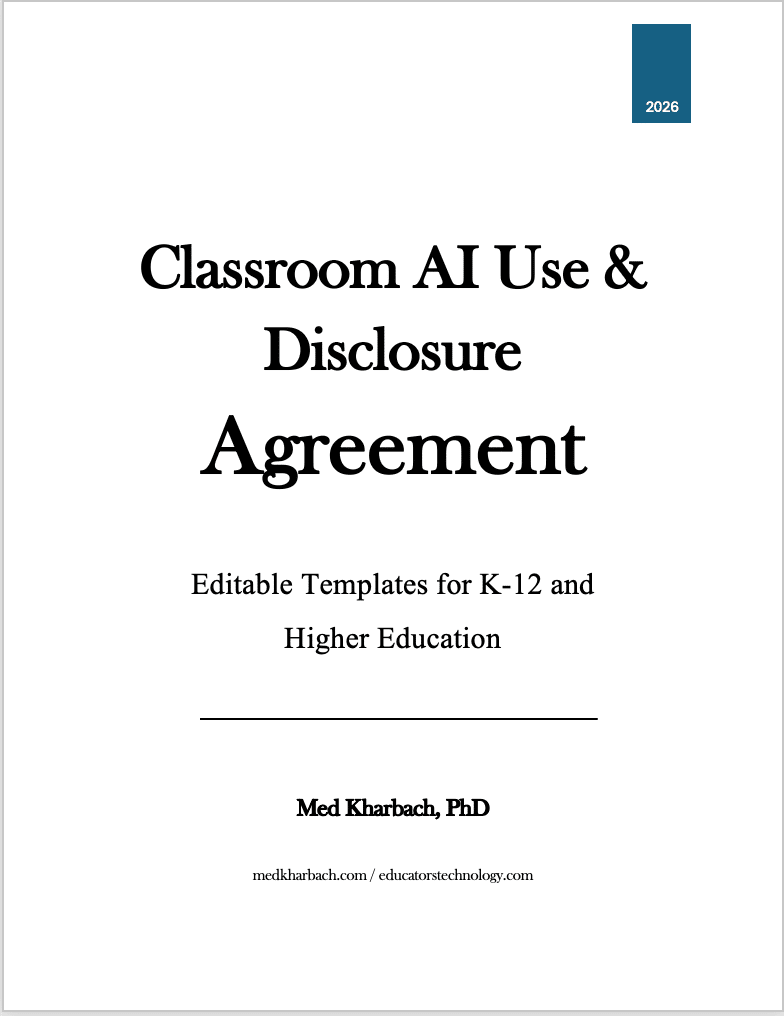
The master is everything the three separate editions contain, gathered in one Word file with a unified introduction. The document includes:
- A combined cover page
- Copyright and Creative Commons license information
- A full introduction (around 1,000 words) that explains the framework, the rationale for separate editions by grade band, the choice of “agreement” over “policy,” the origin of the project, and the connection to the Perkins, Roe, and Furze AI Assessment Scale
- The Elementary edition (K-5): six pages built around a three-level system (Stop / Ask First / Use Together), with a teacher guidance page, student agreement, reflection card, family note, and classroom poster
- The Middle and High School edition (Grades 6-12): six pages built around a four-level scale (Levels 0-3), with teacher guidance, student agreement, disclosure form, quick guide, and family note
- The Higher Education edition: eight pages built around the full five-category Perkins, Roe, and Furze AI Assessment Scale, with instructor guidance, syllabus-ready policy, assignment-level table, disclosure form, reflective statement, privacy checklist, and student acknowledgement form
All three editions in the master are identical to the standalone versions. The master adds the front matter and the connective introduction.
The Introduction Is the Glue
The introduction is the piece I’m most attached to in the master document. It walks through the pedagogical reasoning behind class-level AI agreements, the difference between an agreement and a policy, the developmental case for separate editions, and the broader argument I’ve been making across this work: AI integration in education is fundamentally a pedagogy problem.
The introduction also names the Perkins, Roe, and Furze AI Assessment Scale as the conceptual anchor for the three-level, four-level, and five-category systems used across the editions. Readers who want the philosophy without the templates can read the introduction on its own. Readers who want the templates without the philosophy can skip to the edition that matches their grade band.
Why a Master Document at All
Three audiences benefit most from the combined file.
The first is school administrators and curriculum leaders. K-12 schools that want a unified AI policy framework across all grade levels can use the master as a starting point. The three editions, read together, show how AI use expectations should shift as students develop.
Professional development facilitators are the second group. PD sessions on AI in education often include teachers from different grade bands in the same room. The master lets the facilitator point to one document for all of them.
Parents make the third group. Parents thinking about how AI use should evolve from kindergarten to college can read the master to see the full developmental picture. Most parents don’t need every detail, but seeing the framework helps them have better conversations with their kids and with their kids’ teachers.
Companion Editions
If you teach a specific grade band, the standalone editions may be a better fit. The Elementary edition post covers the three-level system and the family note for K-5. For Grades 6-12, see the Middle and High School edition, built around a four-level scale and a disclosure form. The Higher Education edition uses the full five-category Perkins scale and a modular structure.
Download the Master Document
The full editable Word file is here: https://medkharbach.com/wp-content/uploads/2026/05/AI-Agreement-Master-Guide.docx
The work is shared under a Creative Commons Attribution-NonCommercial-ShareAlike license. Use it, adapt it, share it with your colleagues. If you build on this work in ways that benefit your specific institution or context, I’d love to hear how.