Finding a readable introduction to a topic can take longer than expected. A search for ancient Egypt, fractions, or photosynthesis may lead students to pages written for adults or resources that require an account. In this Ducksters review, I look at a website that brings short educational articles, quizzes, and games together in one place.
I would consider Ducksters for introductory reading, guided research, and topic review. Its usefulness depends on choosing a suitable page and giving students a clear task to complete.
What Is Ducksters?
Ducksters is an educational website for children owned by Technological Solutions, Inc. Its resources cover history, biographies, geography, science, mathematics, and other subjects. The site also includes entertainment content, such as jokes, sports information, and games. Its articles aim to provide informative explanations that children can read and explore.
The pages reviewed were publicly accessible without registration or payment. Teachers can share an individual article with students, who can open it directly in a browser.
My assessment is that much of the content would be useful for upper elementary learners and some middle school students needing an introduction or refresher. That is a practical judgment, not a verified reading-level classification. Teachers should check each page against their students’ reading needs.
Ducksters Review: Main Features
Educational Articles Across Subjects
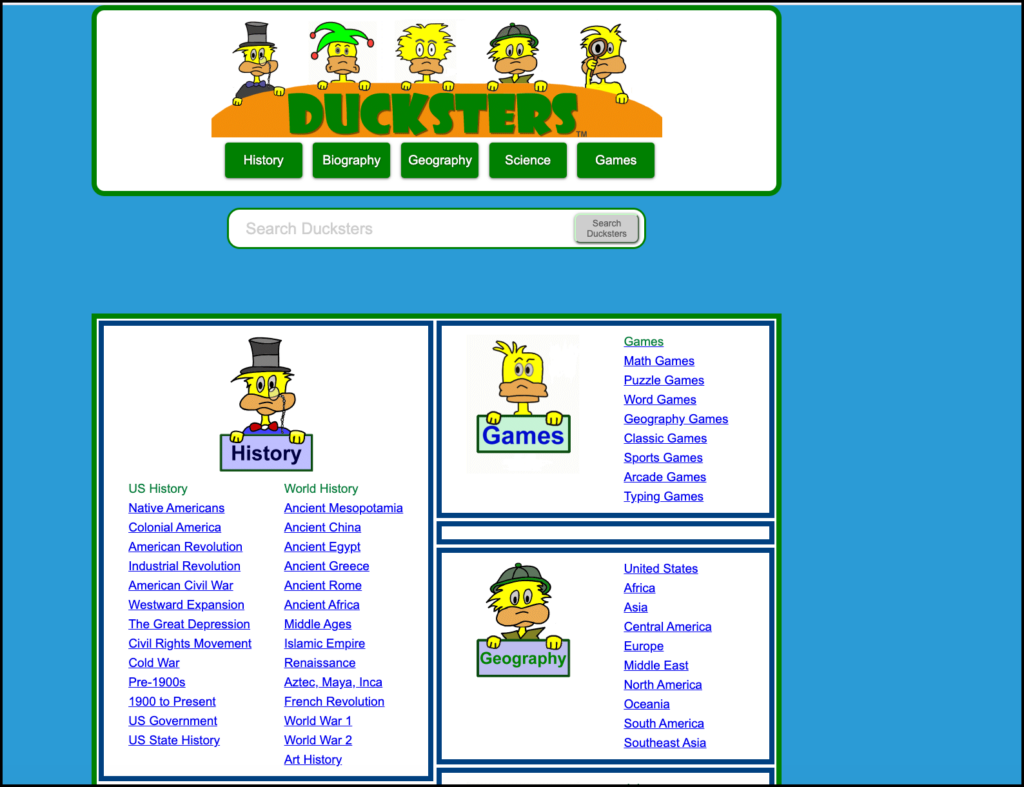
Ducksters organizes resources by subject and topic. Its history collection includes ancient civilizations, major historical periods, and extensive coverage of United States history. The biography section includes inventors, scientists, artists, civil rights leaders, and other historical figures.
Science resources include biology, chemistry, physics, and Earth science. The biology section, for example, links to explanations of cells, genetics, the human body, plants, and microorganisms. Mathematics resources cover topics including multiplication, division, fractions, decimals, algebra, and geometry.
For teaching, I see these pages as starting points. Students can acquire basic vocabulary and background information before working with a more detailed text, an investigation, or a primary source.
Quizzes Connected to Reading
Some articles link to quizzes based on the accompanying text. The photosynthesis page, for instance, includes a ten-question quiz. Its quiz page provides a submission button, a score area, and answer feedback. It also links to a printable version for practice or a webquest.
I would use these quizzes for a quick comprehension check, then add a question that requires explanation. Students might identify an answer they initially misunderstood and explain how the article helped them reconsider it.
A correct quiz response tells us something about the student’s answer. A follow-up explanation gives us more information about their understanding.
Recorded Readings on Selected Pages
Selected articles include a recorded reading. The photosynthesis article offers an audio player alongside its text and illustrations.
This provides another way to approach the material. A teacher could invite students to listen while following the text, pause to discuss unfamiliar terms, and return to a section when preparing an explanation.
Check the individual article before planning an audio-supported activity. I would not assume that every page offers a recording.
Geography Games and Puzzles
Ducksters’ geography games include activities for identifying countries, capitals, and flags. The collection also offers regional crossword puzzles and word searches, with online and printable options.
These activities could support short practice sessions before or after a geography lesson. I would select a specific game and pair it with a relevant question. After locating countries, for example, students could describe their positions relative to neighbouring countries or bodies of water.
Citation Help and Reference Lists
Ducksters’ About page explains that content pages provide links to MLA or APA citation information. It also states that many subject sections include a “Works Cited” page listing references used for that section.
This is useful when introducing source acknowledgment. Students can learn to record the title and address of a page, check the citation information, and distinguish the page they read from the sources listed behind it.
I would explain that a reference list helps us investigate a resource. Its presence alone does not establish that every claim is accurate.
Ways Teachers Can Use Ducksters
The following are suggested activities you can adapt to your curriculum and learners.
| Classroom purpose | Suggested activity |
|---|---|
| Introduce a topic | Read a selected article, identify unfamiliar vocabulary, and write two questions for further investigation. |
| Guide early research | Ask students to collect relevant facts, record the page they used, and verify one claim with another source. |
| Develop biography writing | Have students organize information into a timeline and explain which events they consider significant. |
| Review a science concept | Combine an article with a labelled diagram and a short explanation in the student’s own words. |
| Practise geography | Assign a map activity, followed by a description of locations and geographical relationships. |
| Teach source evaluation | Compare a Ducksters page with another resource and discuss differences in detail, evidence, and perspective. |
For a biography activity, I would move beyond asking students to list dates and accomplishments. Invite them to explain how a person’s circumstances shaped their work and identify a question the introductory article leaves unanswered.
For research assignments, provide a small set of direct links. This makes the search manageable and keeps attention on reading, selecting information, and explaining its relevance.
Is Ducksters Reliable?
Ducksters describes its articles as drawing on multiple sources for fact verification. Its Teachers and Librarians page also states that articles are proofread by a librarian with an MLS qualification. These are the website’s descriptions of its editorial process.
I would use Ducksters as an introductory reference and check important claims against other appropriate sources. Simplified explanations can help students enter a topic, but further reading is necessary when an assignment requires detailed evidence or competing interpretations.
In history lessons, this could mean comparing the overview with a museum resource, historical document, or account representing another perspective. In science, students could compare the explanation with their textbook or an appropriate scientific organization’s resources.
Related: Kahoot Review
Advertising, Privacy, and Classroom Use
Ducksters displays advertising. Its privacy policy states that the website does not collect identifying contact information through registration, but it describes analytics, cookies, advertising technologies, device information, and server logs. An account-free website still involves data collection.
Ducksters states that it is certified by the kidSAFE Seal Program. I would still preview assigned pages and check the resource against school requirements, particularly where third-party content or external links are involved.
The site also has copyright restrictions. Although specific activities offer printable versions, its general terms restrict copying and redistributing content without permission. Use the designated print options and share direct links when assigning articles.
My Assessment
Ducksters is worth considering when you need a brief topic introduction, a guided reading resource, or a short practice activity. Its subject organization makes it relatively easy to assemble a small collection of readings around a lesson.
I would begin with one article and one purposeful task. Ask students to explain a concept, verify a claim, or develop a question for further research. That gives the reading a clear role and helps you judge whether the resource meets your students’ needs.