The classroom collection · 06
Help students see and explain their thinking.
Hands-on tools for numbers, fractions, shapes, measurement, and mathematical reasoning. Below are twelve product ideas, with practical uses and details to check before you choose.
As an Amazon Associate I earn from qualifying purchases. If you buy through an affiliate link on this page, I may earn a commission at no additional cost to you.
Explore the collection
Choose for your students, space, and budgetThe photos and buttons open the featured products on Amazon. Check the individual listing for specifications, age guidance, and what is included.
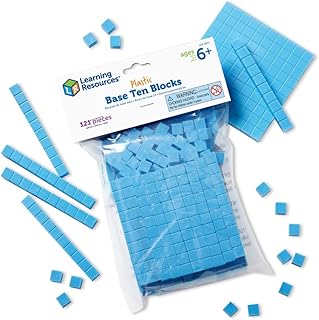
Learning Resources Base Ten Blocks Smart Pack
Make place value visible with blocks students can group and trade. Use them to model a number, then connect the model to a drawing and written equation.
Useful for: Place value and regrouping
View on Amazon ↗
Learning Resources Fraction Tower Equivalency Cubes
Build and compare fractions side by side to explore equivalence. Ask students to explain why two different combinations can represent the same amount.
Useful for: Fractions and equivalence
View on Amazon ↗
Learning Resources MathLink Cubes — Set of 100
Connect cubes to build number combinations, patterns, and measurement models. Invite students to show more than one way to make the same total.
Useful for: Counting and early operations
View on Amazon ↗
Learning Resources Magnetic Ten Frame Answer Boards
Represent quantities on ten frames and discuss how many spaces are filled or empty. Use the boards for quick responses and conversations about making ten.
Useful for: Number sense and mental math
View on Amazon ↗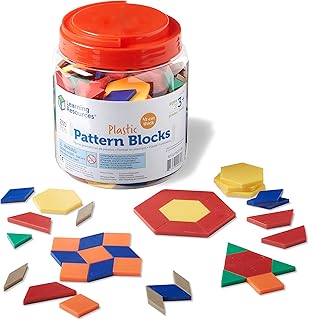
Learning Resources Plastic Pattern Blocks
Combine shapes to create designs and explore how smaller shapes fit inside larger ones. Ask students to describe their patterns using mathematical language.
Useful for: Geometry, patterns, and shape composition
View on Amazon ↗
Learning Resources View-Thru Geometric Solids
Give students three-dimensional shapes to handle, compare, and describe. Connect their observations to drawings and discussions of faces, edges, and vertices.
Useful for: Three-dimensional geometry
View on Amazon ↗
Learning Resources Place Value Disks
Arrange labeled disks to represent numbers and explain operations. Check the included place values against your lessons before choosing a set.
Useful for: Place value and explaining calculations
View on Amazon ↗
Learning Resources Time Activity Set
Build practice around reading and representing times. Have students connect a clock model with a written time and an everyday classroom event.
Useful for: Telling time and daily schedules
View on Amazon ↗
Learning Resources Giant Magnetic Array Set
Make multiplication visible with rows and columns on a magnetic surface. Ask students to connect each arrangement to repeated addition and related multiplication facts.
Useful for: Multiplication and arrays
View on Amazon ↗
Learning Resources Two-Color Counters
Use two colors to represent parts of a total or different quantities. Students can rearrange counters, compare models, and write equations to match their thinking.
Useful for: Number combinations and operations
View on Amazon ↗
Learning Resources Pretend & Play Money
Create a classroom shop where students count amounts and compare ways to pay. Check that the currency and denominations match the lessons you teach.
Useful for: Money, counting, and making change
View on Amazon ↗
Learning Resources Baby Bear Counters
Set up hands-on sorting, counting, and pattern activities with bear counters. Ask students to explain their sorting rule and find another way to organize the same collection.
Useful for: Early counting, sorting, and patterns
View on Amazon ↗Before you choose
- Choose materials that represent the mathematical idea you want students to explain.
- Decide whether the set is for a teacher demonstration, a small group, or independent work.
- Plan how students will connect the objects to drawings, language, and written symbols.