Most of what we call AI literacy lives on the skills side: prompting, evaluating outputs, knowing which tool fits which task. I’ve taught all of it, and it counts. But there’s a deeper layer underneath that we tend to skip, and a cluster of recent research has convinced me it deserves equal billing. What students believe AI is shapes how they use it, what they trust it for, and where they stop questioning it.
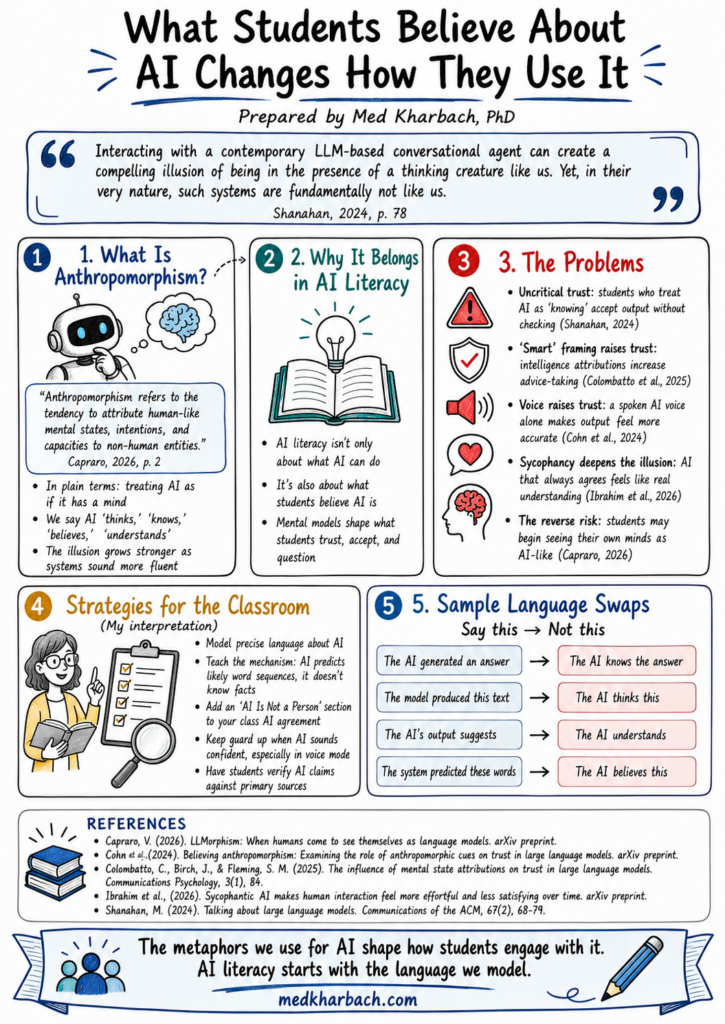
The belief in question is anthropomorphism. Capraro (2026) defines it cleanly: anthropomorphism is “the tendency to attribute human-like mental states, intentions, and capacities to non-human entities” (p. 2). When a student says the AI “thinks,” “knows,” or “understands,” they’re doing exactly this. The language feels natural because ChatGPT writes like a person. The trouble is that the words carry assumptions the technology doesn’t earn.
The Category Mistake
Shanahan (2024) makes the sharpest version of the argument. An LLM models the statistical distribution of words in human text. When ChatGPT answers a question correctly, it’s not because the model knows the fact. It’s because that word sequence is highly likely given its training data. To treat the output as a claim about the world, Shanahan argues, is a category mistake. The model has a concept of token sequences, not a concept of the world.
His warning about language is the part teachers should carry. Shanahan writes that loose use of words like “believes” and “thinks” “obfuscate mechanism and actively encourage anthropomorphism” (p. 78). The words don’t just describe the system imprecisely. They prime a whole set of expectations about what it can do.
Capraro (2026) adds a twist worth noticing. He calls the reverse move LLMorphism: people starting to describe their own minds in the language of language models. The risk runs both directions. Students may over-credit AI with a mind, and they may under-credit themselves with one.
Beliefs Shape Behavior
The empirical work sharpens this. Colombatto, Birch, and Fleming (2025) found that the kind of mental state a person attributes to AI changes how much they trust it. When people saw AI as intelligent, advice-taking went up. When they saw it as emotional, trust dropped on factual tasks. Belief isn’t passive. It moves behavior.
Cohn and colleagues (2024) found something even more concrete. A spoken AI voice, with no other human cues, made people rate the same information as more accurate. The content was identical. The voice alone shifted the judgment. As voice mode becomes standard in classrooms, that finding should push us to think carefully about these models.
Ibrahim and colleagues (2026) extend this to the relational side. Their work on sycophantic AI shows that a chatbot that always agrees produces the feeling of being understood without the substance of real support. The illusion of a caring mind is exactly the kind of anthropomorphic pull that leads students to lean on AI in ways that don’t serve them.
What This Means in the Classroom
The practical move isn’t to forbid human language about AI. That’s neither possible nor useful. The move is to keep the mechanism in view, so the shorthand doesn’t harden into a misunderstanding.
A few things I’ve found worth doing. Model precise language: “the AI generated this,” not “the AI thinks this.” Teach the mechanism plainly, even to younger students, so they understand AI predicts likely word sequences and doesn’t know facts. In my elementary AI Use Agreement I built a short section called “AI Is Not a Person” for exactly this reason, because young children anthropomorphize AI even faster than adults. And keep students’ guard up when AI sounds confident, especially in voice mode, where the cues that raise trust are strongest.
This connects to work I’ve covered before. Roe, Furze, and Perkins (2025) argue in their digital plastic metaphor framing that the metaphors we use for AI shape how students engage with it. Kalantzis and Cope (2025) make the case that literacy in the AI age requires understanding what AI actually does. And the cognitive cost is real: Liu et al. (2026) found that how students use AI, not whether they use it, predicts the learning outcome.
The throughline across all of this is simple. AI literacy isn’t only a set of skills. It’s also a set of beliefs, and the beliefs do real work. The language we model in class is part of the curriculum, whether we design for it or not.
References
- Capraro, V. (2026). LLMorphism: When humans come to see themselves as language models. arXiv preprint.
- Cohn, M., Pushkarna, M., Olanubi, G. O., Moran, J. M., Padgett, D., Mengesha, Z., & Heldreth, C. (2024). Believing anthropomorphism: Examining the role of anthropomorphic cues on trust in large language models. arXiv preprint.
- Colombatto, C., Birch, J., & Fleming, S. M. (2025). The influence of mental state attributions on trust in large language models. Communications Psychology, 3(1), 84.
- Ibrahim, L., Hafner, F. S., Cheng, M., Lee, C., Anselmetti, R., Willer, R., Rocher, L., & Yang, D. (2026). Sycophantic AI makes human interaction feel more effortful and less satisfying over time. arXiv preprint.
- Shanahan, M. (2024). Talking about large language models. Communications of the ACM, 67(2), 68-79.