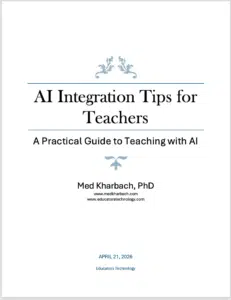
As 2025 comes to a close, I spent some time reviewing the resources I have shared with educators across the world over the past year. Rather than relying on impressions or social media engagement, I went straight to the data.
I looked at download rates on my website and curated this collection based on what educators actually chose to access, save, and use. The guides featured here are not selected because they are new or flashy. They earned their place through consistent use.
What These Guides Have in Common
Taken together, these guides form a practical foundation for AI literacy in education. They are designed to support teachers, faculty, and researchers who want to engage with AI in ways that remain thoughtful, pedagogically grounded, and professionally responsible.
Across the collection, the focus stays on a few core principles:
• Understanding how generative AI tools work and where their limits sit
• Using AI to support teaching, assessment, and research without replacing professional judgment
• Making informed choices about AI tools in instruction
• Addressing issues of ethics, data privacy, bias, and academic integrity in concrete terms
• Building confidence in AI use through understanding and practice
These guides aim to reduce both fear and hype. AI is neither a shortcut nor a threat by default. It becomes meaningful only when educators understand how and why they use it.
Who These Guides Are For
If you are new to AI in education, these guides can help you get oriented without the noise. They provide language, concepts, and practical entry points that make the landscape easier to navigate.
If you already use AI tools in your teaching or research, these resources can help you slow down, reflect, and refine your practice. AI use matures through questioning assumptions, not through accumulating tools.
AI is now part of everyday educational life. The challenge ahead is not adoption. It is judgment. The real work lies in learning how to engage with AI in ways that support learning, protect learners, and preserve the human dimensions of education.
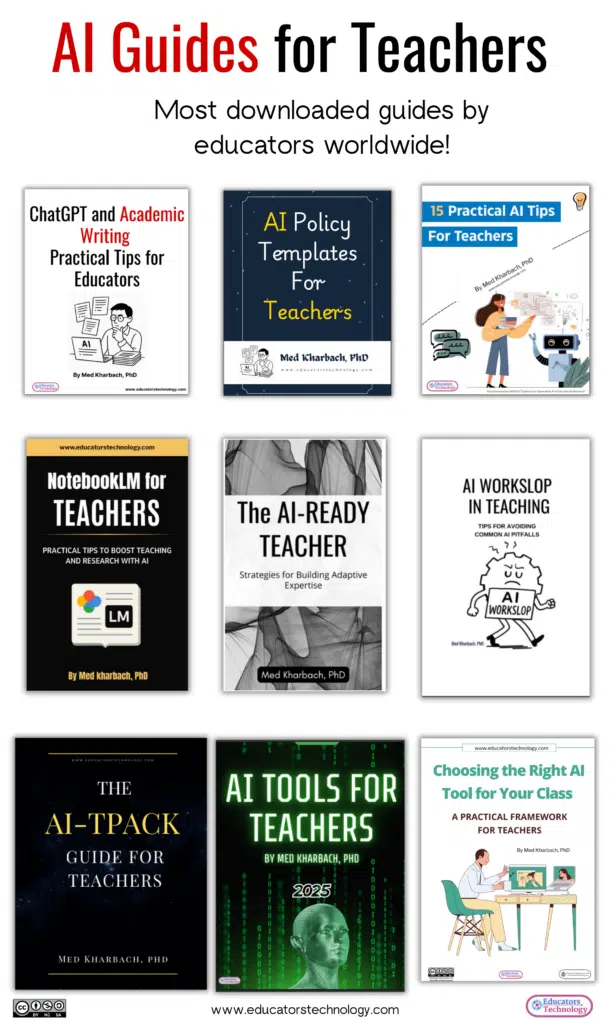
Here are the guides:
1. ChatGPT and Academic Writing Practical Tips for Educators
https://www.educatorstechnology.com/wp-content/uploads/2025/12/6-Important-ChatGPT-tips-to-Keep-Your-Writing-Original-Ethical.pdf
2. AI Policy Templates For Teachers
https://www.educatorstechnology.com/wp-content/uploads/2025/12/AI-Agreement-Templates-3.pdf
3. 15 Practical AI Tips For Teachers
https://www.educatorstechnology.com/wp-content/uploads/2025/11/15-Practical-AI-Tips-for-teachers.pdf
4. The AI-READY TEACHER
https://www.educatorstechnology.com/wp-content/uploads/2025/11/What-is-Adaptive-Expertise.pdf
5. NotebookLM for TEACHERS
https://www.educatorstechnology.com/wp-content/uploads/2025/11/NotebookLM-Guide-Updated.pdf
6. AI WORKSLOP IN TEACHING
https://www.educatorstechnology.com/wp-content/uploads/2025/11/AI-Workslop-Guide.pdf
7. THE AI-TPACK GUIDE FOR TEACHERS
https://www.educatorstechnology.com/wp-content/uploads/2025/11/AI-Tpack.pdf
8. AI TOOLS FOR TEACHERS
https://www.educatorstechnology.com/wp-content/uploads/2025/10/AI-Tools-for-Teachers.pdf
9. Choosing the Right AI Tool for Your Class
https://www.educatorstechnology.com/wp-content/uploads/2025/09/how-to-choose-the-right-ai-tool.pdf