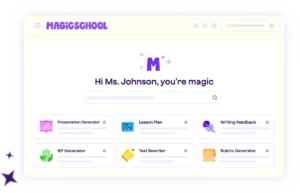
MagicSchool AI is an education-focused AI platform designed to help teachers plan lessons, create instructional materials, provide feedback, communicate with families, and complete routine administrative work.
I have been using MagicSchool for some time and find it worth featuring here on Educators Technology. What began as a collection of teacher-focused AI generators has developed into a broader platform for teachers, students, schools, and districts.
MagicSchool currently advertises more than 80 AI tools for educators, an increase from the 60-plus tools available when I first wrote this review. It has also added or expanded features such as Student Rooms, student learning insights, assigned quizzes, class writing feedback, a presentation generator, Studio Mode, and integrations with Google, Microsoft, and several learning management systems.
If you prefer a video demonstration, I have included my MagicSchool tutorial near the end of the post. Keep in mind that the video shows an earlier version of the interface, so some tools and menus may now look different.
What Is MagicSchool AI?
MagicSchool is an AI platform built around common teaching and school-related tasks. Instead of beginning with a general chatbot and writing every prompt from scratch, educators choose a purpose-built tool such as a lesson plan generator, rubric generator, quiz creator, worksheet generator, or report card comment writer.
Most tools follow a similar process:
- Select the tool you need.
- Enter details such as grade level, subject, topic, standards, or learning objectives.
- Add any relevant text, instructions, or supporting material.
- Generate a draft.
- Review, edit, and export the result.
This makes MagicSchool more approachable for teachers who are new to generative AI or uncertain about how to structure an effective prompt.
MagicSchool is similar in some respects to Brisk Teaching and Eduaide. All three provide education-specific AI workflows for tasks such as lesson planning, differentiation, assessment, resource creation, and feedback.
MagicSchool, however, has grown beyond a library of generators. Its current platform includes tools that teachers can assign to students, classroom activity spaces, learning insights, output editing, quizzes, writing feedback workflows, and school-level administrative controls.
Related: AI Lesson Plan Tools for Teachers
MagicSchool AI Tools for Teachers
MagicSchool currently provides more than 80 teacher tools. They cover lesson planning, assessment, differentiation, content creation, student support, communication, and professional responsibilities.
Here are some of the most useful MagicSchool AI tools:
Lesson Plan Generator
Create a draft lesson plan based on a topic, objective, grade level, or curriculum standard. Teachers can use the result as a starting point and adapt the activities, timing, and assessment to their students.
Unit Plan Generator
Develop a multi-lesson unit plan around a topic, set of standards, learning objectives, and proposed length.
Presentation Generator
Generate exportable slides from a topic, video, or text. This is one of the notable additions since the original version of this review.
Rubric Generator
Create a rubric for an assignment using criteria supplied by the teacher. The output is organized in a table that can be edited before use.
Choice Board Generator
Produce a choice board for an assignment using Universal Design for Learning principles. The teacher can review the options and adjust them for the available time, resources, and student needs.
Worksheet Generator
Generate a worksheet based on a topic or supplied text. As with any AI-generated instructional material, the questions and answers need to be checked before the worksheet is shared.
Multiple-Choice Quiz Generator
Create multiple-choice questions using a topic, text, standard, or set of criteria. MagicSchool’s newer quiz workflow also allows teachers to assign low-stakes formative assessments and view real-time summaries.
Class Writing Feedback
Review written assignments in batches and generate feedback based on a teacher-provided rubric. Teachers can review, personalize, and send the feedback rather than passing the AI output directly to students.
Writing Feedback
Generate strengths and areas for growth for an individual piece of student writing using custom criteria.
Report Card Comments
Draft report card comments based on a student’s strengths and areas for improvement.
YouTube Video Questions
Generate guiding or comprehension questions aligned with a YouTube video.
YouTube Video Summarizer
Produce a summary of a YouTube video at a selected level of detail.
Text Summarizer
Condense a passage into a specified length or format.
Project-Based Learning Generator
Create a draft project plan informed by principles of project-based learning.
Chat With Documents
Upload a document and ask questions about its content. This can be useful for examining curriculum documents, readings, lesson materials, and policy documents.
Survey Creator
Generate questions for collecting information or feedback.
IEP Generator
Produce a draft individualized education program based on information supplied by the educator. Because an IEP is a formal and consequential document, any generated content requires careful professional review and must follow the procedures and legal requirements of the educator’s jurisdiction.
Professional Email Generator
Draft communications for colleagues, administrators, students, or families.
Idea Generator
Use AI as a brainstorming partner when you need possible lesson activities, project directions, discussion questions, or instructional approaches.

Raina: MagicSchool’s AI Chatbot
Raina is MagicSchool’s general-purpose AI assistant for educators. Unlike the platform’s individual generators, which are built around specific tasks, Raina provides a conversational space where you can ask questions, develop an idea over several exchanges, and refine the response through follow-up prompts.
You might use Raina to:
- Review a lesson plan
- Suggest alternative teaching activities
- Adapt an activity for a different grade level
- Generate discussion questions
- Brainstorm assessment ideas
- Revise classroom instructions
- Explore instructional approaches
- Develop a teaching resource through several iterations
The quality of Raina’s response depends heavily on the information included in the request. A useful prompt should specify the grade level, subject, learning objective, lesson length, available resources, student needs, and desired output.
Instead of asking:
Create a lesson about ecosystems.
A more helpful request would explain the class context, intended learning, time available, and the type of activity or assessment required.
Student Rooms and MagicSchool Tools for Students
Student Rooms are one of the most significant developments since the original review. They allow teachers to choose and configure AI tools, establish learning goals, and share the resulting space with students.
MagicSchool now advertises more than 50 student tools for activities such as tutoring, writing feedback, and guided learning. Rather than sending students to an unrestricted general chatbot, a teacher can select the tools and structure the type of interaction available within the room.
Depending on the plan, teachers may also have access to student learning insights that show participation and engagement.
This changes MagicSchool from a tool used only behind the scenes by teachers into a platform that can also support teacher-designed student activities. Student-facing AI still requires clear instructions, supervision, and alignment with school policies.
Quizzes and Class Writing Feedback
MagicSchool’s current platform includes two classroom workflows worth highlighting.
With Quizzes, teachers can generate and assign low-stakes formative assessments such as exit tickets. The system provides real-time summaries that can help the teacher see patterns in student responses.
With Class Writing Feedback, teachers can process written assignments in batches using a supplied rubric. The AI produces suggested feedback, but the teacher can review and personalize it before it reaches students.
The distinction matters. AI-generated feedback should support the teacher’s judgment, not replace it. Teachers still need to read the work, check whether the comments are accurate, and ensure that the feedback reflects the assignment and the student’s actual needs.
Studio Mode and Export Options
MagicSchool Plus includes Studio Mode, an editing environment for working with generated outputs. Teachers can format text, organize the structure, add images, and prepare content for export.
The platform supports exports to Google and Microsoft products, including Google Docs and Slides. This makes it easier to move a generated resource into the tools a school already uses rather than copying and reformatting everything manually.
MagicSchool also advertises integrations with Google Classroom, Canvas, Clever, ClassLink, Schoology, and Microsoft. Some full SIS and LMS integrations are limited to Enterprise plans.
MagicSchool AI Privacy and Safety
MagicSchool states that it does not use teacher or student data to train its AI models. The company also lists FERPA, COPPA, GDPR, SOC 2, and New York Education Law 2-D among its security and compliance commitments and reports that it has received Common Sense Privacy certification.
Its platform includes safeguards intended to flag possible personally identifiable information, bias, and factual errors. Enterprise plans add district-level moderation, tool controls, custom data agreements, and other administrative safeguards.
These provisions do not remove the need for local review. Before entering student information or assigning an AI tool, educators should check their school or district’s approved-tool list, data-protection requirements, and AI-use policy. Avoid placing unnecessary personally identifiable or sensitive student information into any AI system.
You can review MagicSchool’s current claims and documentation through its Trust Center.
MagicSchool AI Pricing
MagicSchool currently offers three plans: Free, Plus, and Enterprise. Pricing and features may change, so check the official MagicSchool pricing page before subscribing.
| Plan | Current price | Main features |
|---|---|---|
| Free | $0 | More than 80 teacher tools, Raina, quizzes, class writing feedback, basic support, and professional development |
| Plus | $12.99 USD monthly or $8.33 per month when billed annually | Everything in Free, plus unlimited generations, unlimited output history, Studio Mode editing, 50+ student tools, Student Rooms, learning insights, advanced features, and MagicSchool Labs |
| Enterprise | Custom pricing | Institution-wide access, SSO, SIS/LMS integrations, district alignment, custom tools, moderation controls, dashboards, onboarding, and dedicated support |
The annual Plus rate comes to $99.96 USD per year. The free plan provides substantial access, but it does not include unlimited generations, complete output history, Student Rooms, or the full collection of student tools.
MagicSchool Labs, available with Plus and Enterprise, gives users early access to features before their wider release.
MagicSchool Video Tutorial
The following video walks through the process of using MagicSchool:
Watch my MagicSchool AI tutorial on YouTube
Because MagicSchool has added new tools and redesigned parts of the platform since the video was recorded, the current interface may differ from what appears in the tutorial.
What to Keep in Mind When Using MagicSchool
MagicSchool can reduce the time required to produce a first draft, but the generated content is not automatically accurate, appropriate, or ready for classroom use.
Before using an output, check:
- Factual accuracy
- Curriculum and standards alignment
- Reading level
- Cultural and contextual appropriateness
- Accessibility
- Quality of questions and answer keys
- Suitability for your particular students
- Accuracy of any feedback or report card comments
- Protection of student information
I would treat the platform as a drafting and brainstorming assistant. The teacher remains responsible for the final instructional decisions and for everything shared with students or families.
Final Thoughts
MagicSchool has changed considerably since I first reviewed it. It still offers the familiar lesson planners, worksheet generators, rubrics, summaries, and communication tools, but it now includes more than 80 teacher tools and a growing set of classroom and student-facing features.
The most important additions are Student Rooms, more than 50 student tools, assigned quizzes, class writing feedback, student learning insights, the Presentation Generator, Studio Mode, expanded exports, and deeper school-system integrations.
If you already use Brisk Teaching or Eduaide, parts of MagicSchool will feel familiar. Its main appeal is having a large collection of education-specific AI workflows, a conversational assistant, and teacher-managed student tools in one platform.
MagicSchool can certainly save time, particularly when creating first drafts of routine instructional materials. But its output still requires the teacher’s subject knowledge, understanding of students, and professional judgment.