Students are already developing AI literacy in front of us. They’re doing it in messy chat windows, late-night study sessions, coding help requests, essay drafts, exam preparation, and moments of confusion when they don’t want to ask another person for help.
That’s why I found Ammari, Chen, Zaman, and Garimella’s 2026 study so useful. Their paper, Learning to live with AI: How students develop AI literacy through naturalistic ChatGPT interaction, looks at how undergraduate students actually used ChatGPT across one academic year. The authors analyzed 10,536 messages from 36 students, which gives us something many AI literacy discussions still lack: a view of student AI use as it happens naturally.
Ammari et al. show that AI literacy doesn’t grow only through formal lessons, policy statements, or classroom warnings. Students also build it through use. They try things. They get weak answers. They repair prompts. They trust too quickly, then doubt. They use ChatGPT for schoolwork, but also for reassurance, planning, practice, and emotional support.
ChatGPT and AI Literacy in Everyday Student Work
The first use Ammari et al. identify is the most familiar one:
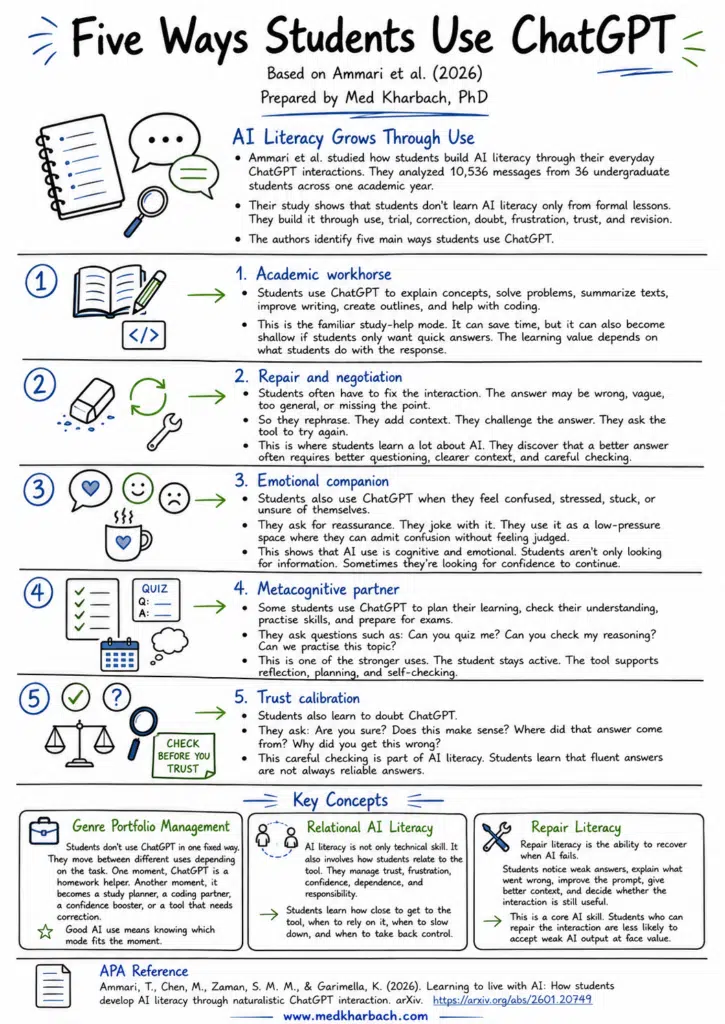
1. ChatGPT as an academic workhorse
Students use it to explain concepts, solve problems, summarize readings, improve writing, create outlines, and help with coding. Every teacher has seen some version of this already.
This use can support learning, but it can also flatten it. A student who asks ChatGPT to explain a difficult concept, then checks the explanation against course materials and tries to apply it, is doing something productive. A student who copies a quick answer into an assignment has gained very little. The difference lies in what the student does after the answer appears.
This connects with Hawkins et al. (2025) on feedback literacy. AI feedback has value when students know how to question it, judge it, and act on it. The output alone doesn’t teach. The student’s response to the output is where learning begins.
2. Repair and Negotiation
Ammari et al. also describe a second use: repair and negotiation. This is one of the most important parts of the study. Students don’t simply type a prompt and accept the first response. Many of them notice when ChatGPT gives an answer that’s vague, wrong, too general, or disconnected from the task. They rephrase. They add context. They ask the tool to try again. They challenge it.
That repair work is a form of learning. Students discover that AI systems don’t respond magically to intention. They respond to wording, context, examples, constraints, and follow-up. Ammari et al. call attention to this as repair literacy, and I think teachers should take this seriously. Students who can repair an AI interaction are far less likely to accept weak answers at face value.
3. Emotional companion
The third use in the study may make some educators uncomfortable. Ammari et al. found that students also use ChatGPT as an emotional companion. They turn to it when they feel confused, stressed, stuck, or unsure of themselves. They ask for reassurance. They joke with it. They use it as a low-pressure space where they can admit confusion without fear of judgment.
We shouldn’t romanticize this. ChatGPT is not a teacher, counsellor, mentor, or friend. At the same time, the emotional side of learning is real. Students often need confidence before they can re-engage with a difficult task. The risk comes when reassurance turns into dependence, or when students accept overly agreeable responses because the tool makes them feel better.
This is where work on trust and anthropomorphism becomes relevant. Cohn et al. (2024), for instance, show how design cues can affect trust in AI systems. Ammari et al. give us the student side of that problem. Students are not just using a tool. They’re forming a relationship with it, and that relationship affects judgment.
4. ChatGPT as a Metacognitive Partner
The fourth use is much stronger pedagogically: ChatGPT as a metacognitive partner. Some students use it to plan learning, check understanding, prepare for exams, and practise skills. They ask questions such as: Can you quiz me? Can you check my reasoning? Can we practise this topic?
This is the kind of AI use I want to see more often in classrooms. The student remains active. The tool supports reflection, planning, rehearsal, and self-checking. Sidra et al. (2026) make a related point in their work on collaborative AI literacy and metacognition. Productive AI use depends on the student’s ability to monitor the interaction, evaluate the support, and remain responsible for the thinking.
5. Trust Calibration
The fifth use Ammari et al. identify is trust calibration. Students learn to doubt ChatGPT. They ask whether the answer makes sense. They ask where the information came from. They question why the tool got something wrong. This is AI literacy in action.
Teachers often tell students to “verify AI output,” but that instruction can sound abstract. Ammari et al. show what verification looks like in actual use. It begins with hesitation. It grows through repeated encounters with error. It becomes stronger when students have the language and habits to question fluent answers.
What Teachers Can Do With These Five Uses
The sketchnote I created from this paper organizes the five uses visually: academic workhorse, repair and negotiation, emotional companion, metacognitive partner, and trust calibration. I see it as a classroom discussion tool, not just a summary of a paper.
Teachers can use it to ask students: Which of these uses feels familiar to you? Which one helps you learn most? Which one carries the biggest risk? When do you trust ChatGPT too quickly? What do you do when the answer is wrong?
Those questions move AI literacy away from rules alone. They invite students to examine their own habits.
Ammari et al. also introduce a useful idea they call genre portfolio management. Students don’t use ChatGPT in one fixed way. They move across modes depending on the task. One moment it’s a homework helper. Another moment it’s a study planner, coding partner, confidence booster, or tool that needs correction.
Good AI pedagogy should help students name these modes and choose among them with care. That connects with Bilbao-Eraña et al. (2025), who argue that AI literacy for teachers goes far beyond knowing how to use ChatGPT. Teachers need the pedagogical language to guide students through judgment, purpose, and responsibility.
The study also gives us a stronger way to talk about relational AI literacy. AI literacy is technical, but it’s also relational. Students manage trust, frustration, confidence, dependence, and control. They learn when to lean on the tool and when to slow down. They learn when the interaction is helping and when it’s taking over.
For me, that’s the core message of Ammari et al.’s paper. AI literacy grows through guided use, reflective use, and repaired use. Students will keep using ChatGPT. The question is whether we help them use it with better judgment.
Ask them to compare outputs. Ask them to explain their prompts. Ask them to document corrections. Ask them to identify where the AI helped, where it failed, and where their own thinking changed. That’s where AI literacy becomes visible.
References
Ammari, T., Chen, M., Zaman, S. M. M., & Garimella, K. (2026). Learning to live with AI: How students develop AI literacy through naturalistic ChatGPT interaction. arXiv. https://arxiv.org/abs/2601.20749
A short reflection task
Ask students to describe one AI interaction without including private information. What were they trying to do? What did they initially trust? What did they check or change? Have them support their evaluation with an example from the response and a source or reason independent of the chatbot.
Related teaching resources
Explore more in ChatGPT.