I’ve been returning to Parker and Becker’s (2026) paper on AI literacy for researchers because it gives us something many AI discussions still lack: a practical way to think about AI use across the full research process.
Many teachers and graduate students already use AI for searching, summarizing, drafting, translating, coding, outlining, and revising. That part is no longer surprising. The harder question is how to use AI without giving away our judgment.
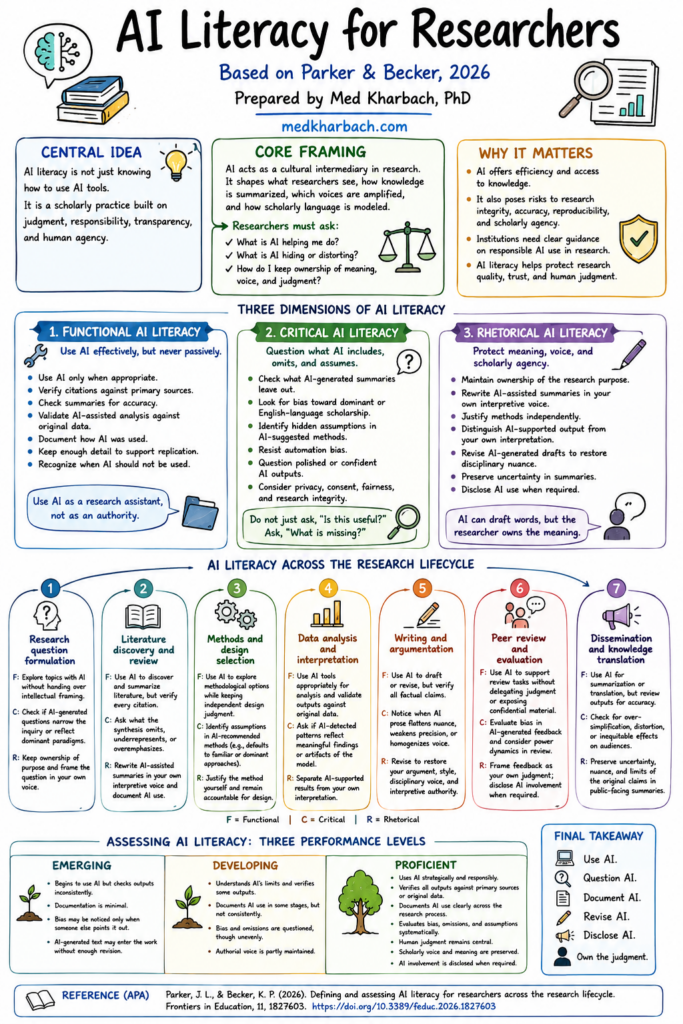
Parker and Becker argue that AI literacy for researchers has three parts: functional, critical, and rhetorical literacy. I find this useful because it moves the conversation away from tool skills alone. A researcher may know how to write a good prompt and still misuse AI. A teacher may get a fluent summary and still miss fabricated citations, weak interpretation, or loss of voice.
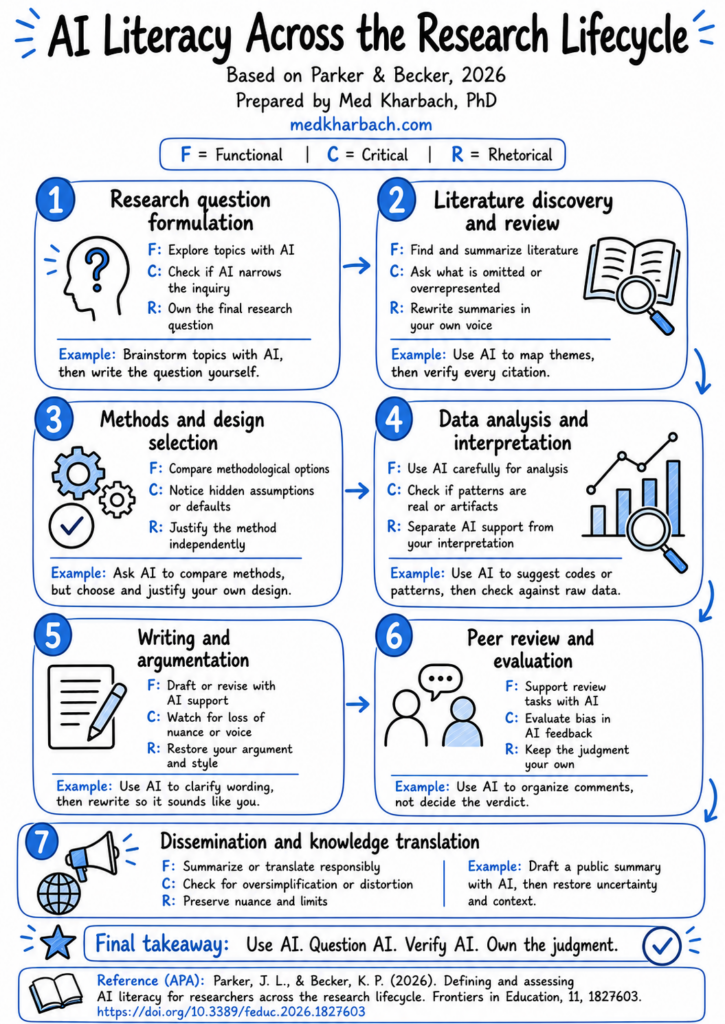
This is why I created the sketchnote around the research lifecycle. My goal was to turn the paper into a practical classroom and research guide that teachers can use with students.
What AI Literacy Means for Teachers
Parker and Becker define functional AI literacy as the ability to use AI effectively and responsibly. For teachers, this can start with simple classroom routines.
Ask students to use AI to brainstorm possible research topics. Then require them to explain which topic they selected, which ones they rejected, and why. This turns AI into a starting point for inquiry, not a shortcut to a final answer.
The same applies to literature review work. Students can ask AI to suggest themes, summarize abstracts, or create a preliminary map of a topic. But the next step must be verification. Every citation needs to be checked against the original source. Every summary needs to be compared with the actual paper. Every claim needs a source trail.
This connects well with the work I discussed in my post on LaFlamme’s (2025) model for scaffolding AI literacy in higher education. Students need structured support, not vague warnings.
Functional AI literacy asks: Can students use AI without becoming passive?
Critical AI Literacy in the Research Process
Parker and Becker’s second dimension is critical AI literacy. This is where teachers can do some of the most useful classroom work.
Give students an AI-generated summary of an article and ask them to mark three things: what the summary includes, what it leaves out, and what it overemphasizes. This small activity can teach students that AI output is never neutral. It selects, compresses, and smooths information.
Another useful activity is the “missing perspective” task. Students ask AI to summarize a research topic. Then they ask: Which populations are missing? Which countries are absent? Which languages or research traditions are centered? Which assumptions does the answer make?
This is especially useful in higher education, where students often treat polished writing as credible writing. AI makes that problem worse because it can produce confident answers even when the evidence is thin.
This connects to Roe et al.’s (2025) work on critical AI literacy, which I covered in my post on AI as “digital plastic.” AI output can look flexible and useful, but teachers have to train students to test its shape, its limits, and its hidden pressures.
Critical AI literacy asks: Can students question the output before they use it?
Rhetorical AI Literacy and Student Voice
The third part of Parker and Becker’s framework is rhetorical AI literacy. This is the part I think many teachers will find most practical.
Students can use AI to draft, revise, simplify, or reorganize. But they need to protect meaning and voice. Teachers can help by adding one simple requirement to AI-assisted writing tasks: a revision note.
Ask students to submit a short note explaining:
- What AI helped with
- What they changed after reviewing the AI output
- What they rejected
- What ideas, examples, or interpretations remained their own
This works for essays, literature reviews, discussion posts, research proposals, and public summaries. It shifts attention from the finished product to the student’s choices.
I also suggest using a “restore your voice” activity. Students paste an AI-polished paragraph beside their original paragraph. Then they identify what changed in tone, precision, nuance, and ownership. After that, they rewrite the paragraph so it keeps the useful improvement but sounds like them again.
This connects with my post on Hyland’s (2026) work on writing in the AI era. Writing is not only production. It is a way of thinking, judging, and positioning oneself in relation to knowledge.
Rhetorical AI literacy asks: Can students keep ownership of meaning?
A Classroom Routine Teachers Can Use
Here is a simple routine teachers can adapt to almost any research assignment.
First, let students use AI for one defined task, such as brainstorming topics, identifying search terms, comparing methods, or improving clarity.
Next, require a verification step. Students must check the AI output against course readings, library databases, original articles, or raw data. Then ask for a judgment step. Students explain what they accepted, revised, rejected, or questioned.
Finally, require disclosure. Students state where AI was used and how it shaped the work. This is simple enough for classroom use, but it does serious pedagogical work. It helps students use AI without hiding the process. It also gives teachers better evidence of learning.
The sketchnote summarizes this with four verbs: use, question, verify, and own.
That is the practical core of AI literacy for researchers and students. AI can support the research process, but the learner must remain responsible for the question, the evidence, the method, the interpretation, and the final judgment.
Here is another sketchnote summarizing the insights from Parker and Becker paper:
References
Parker, J. L., & Becker, K. P. (2026). Defining and assessing AI literacy for researchers across the research lifecycle. Frontiers in Education, 11, 1827603. https://doi.org/10.3389/feduc.2026.1827603