The more AI settles into classrooms, the more it strains the categories we built before it arrived. Plagiarism is the clearest example. For decades, that word carried a stable meaning: take someone else’s words or ideas, fail to credit them, get caught. Generative AI breaks that frame, because the “someone else” is now a machine that can draft, outline, rewrite, translate, and reason on a student’s behalf.
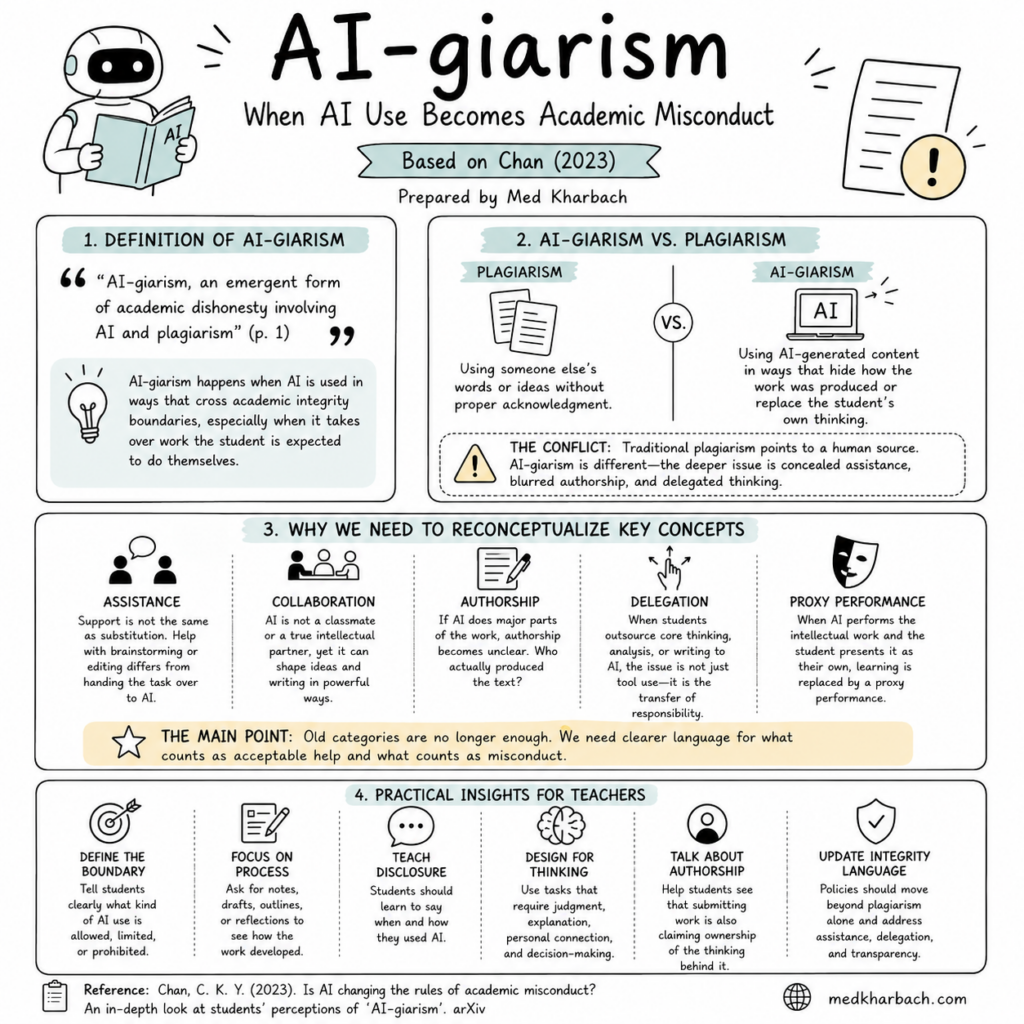
Cecilia Ka Yuk Chan saw this coming early. In a 2023 study, she coined the term “AI-giarism,” which she defines as “an emergent form of academic dishonesty involving AI and plagiarism” (p. 1). The label is catchy. The value of her work is in the questions it forces open.
What Chan’s AI-giarism Study Actually Found
Chan surveyed 393 undergraduate and postgraduate students across disciplines and asked them to judge a range of AI-use scenarios. The pattern she found is the part I find most telling. Students were clear that using AI to generate content outright crosses the line.
They were far more divided on the subtler uses, the brainstorming, the polishing, the restructuring. Chan reads that ambivalence as a symptom of something institutions hadn’t yet supplied: shared definitions and clear policy on what counts as acceptable help.
That gap hasn’t closed much. We’re in 2026 now, with models far more capable than the ones students reacted to in early 2023, and most integrity policies still reduce AI to a yes-or-no question.
The students in Chan’s study already sensed the binary was too crude for what they were actually doing. Sarah Eaton’s notion of postplagiarism takes that intuition further, arguing that in a world of routine human-AI co-writing, the clean line between original and copied work may not hold at all.
The Spectrum Old Plagiarism Categories Miss
The problem the study opens up looks like this to me. AI doesn’t hand a student a stolen paragraph. It takes part in the work, and that participation runs along a spectrum the old vocabulary can’t describe.
At one end is assistance, the kind of help a good study partner or editor gives. Push a little further and assistance becomes collaboration, where the tool shapes ideas and phrasing in real ways. Further still, authorship gets murky: if AI produced the structure and most of the prose, who wrote the text? Past that point comes delegation, and the student has handed off the core thinking itself. At the far end is proxy performance, where the machine does the intellectual work and the student signs it. At that point a stand-in has done the work, and the learning never happened.
Corbin and colleagues put the practical version of this plainly, asking where the line for acceptable AI use in an assessment actually falls. The old language of plagiarism gives us no good way to answer, because it was built to point at a human source, not to map a continuum of machine assistance.
What Teachers Can Do About AI-giarism
So what do we actually do with this? Define the boundary before the assignment, not after, telling students plainly what AI use is allowed, limited, or off-limits for that specific task. I’d also ask for the process, not just the finished product, so notes, drafts, and reflections show how the work developed. Disclosure helps here too. When students learn to say when and how they used a tool, the way we teach them to cite a source, it stops feeling like a confession.
The strongest move is in the task design itself. Dawson and colleagues reframe the whole debate around validity, how well an assessment measures the learning it claims to, and treat cheating as the smaller problem.
An assignment that demands judgment, personal connection, and live decision-making makes proxy performance much harder to fake. In my own courses, a short oral walkthrough of one revision decision tells me more about a student’s thinking than any plagiarism scan ever could. Build the thinking into the assignment, and you don’t need to police the tool nearly as hard.
Chan is careful about what her study can and can’t claim. She used a convenience sample, the technology was changing under her feet as she wrote, and she asked only students, not the educators who have to enforce whatever policy emerges. Those limits are worth holding onto. A 2023 snapshot of student attitudes is a starting point for the conversation.
What’s useful about AI-giarism is the pressure the concept puts on a comfortable assumption: that we already know what cheating is. We don’t have a clean answer anymore. The AI age doesn’t make academic integrity less important. It makes integrity harder to define and more central to everything we ask students to do. That’s the work in front of us.
References
- Chan, C. K. Y. (2023). Is AI changing the rules of academic misconduct? An in-depth look at students’ perceptions of ‘AI-giarism’. arXiv. https://arxiv.org/abs/2306.03358
- Corbin, T., Dawson, P., Nicola-Richmond, K., & Partridge, H. (2025). ‘Where’s the line? It’s an absurd line’: Towards a framework for acceptable uses of AI in assessment. Assessment & Evaluation in Higher Education, 50(5), 705-717. https://doi.org/10.1080/02602938.2025.2456207
- Dawson, P., Bearman, M., Dollinger, M., & Boud, D. (2024). Validity matters more than cheating. _Assessment & Evaluation in Higher Education_, 49(7), 1005–1016. https://doi.org/10.1080/02602938.2024.2386662
- Eaton, S. E. (2023). Postplagiarism: Transdisciplinary ethics and integrity in the age of artificial intelligence and neurotechnology. _International Journal for Educational Integrity_, 19(23). https://doi.org/10.1007/s40979-023-00144-1