After over a decade of writing about edtech on this blog, I’ve started organizing all my AI-in-writing thinking around one question: how do we let students benefit from AI feedback without letting AI do the thinking for them? The PAIRR Model from Sperber, MacArthur, Minnillo, Stillman, and Whithaus (2025) is the cleanest answer I’ve come across this year.
I covered the research in detail on my academic blog at medkharbach.com, including the data from their study of 654 students and the broader research conversation around AI feedback and critical AI literacy. This post is the practical version. The accompanying sketchnote is a one-page walkthrough I built to share with colleagues, and the guide below shows what each step requires from teachers, with sample activities you can adapt for your own writing assignments.
What PAIRR Stands For
PAIRR stands for Peer and AI Review + Reflection. It’s a six-step formative assessment sequence built specifically for writing classes. The order is the whole point of the model. Students draft independently first, then get peer feedback, then get AI feedback, then critically assess both, and finally revise. AI comes after the draft and after peer review, never during.
That sequencing protects what writing instruction is actually trying to build: a student’s own capacity to make rhetorical decisions before any tool weighs in.
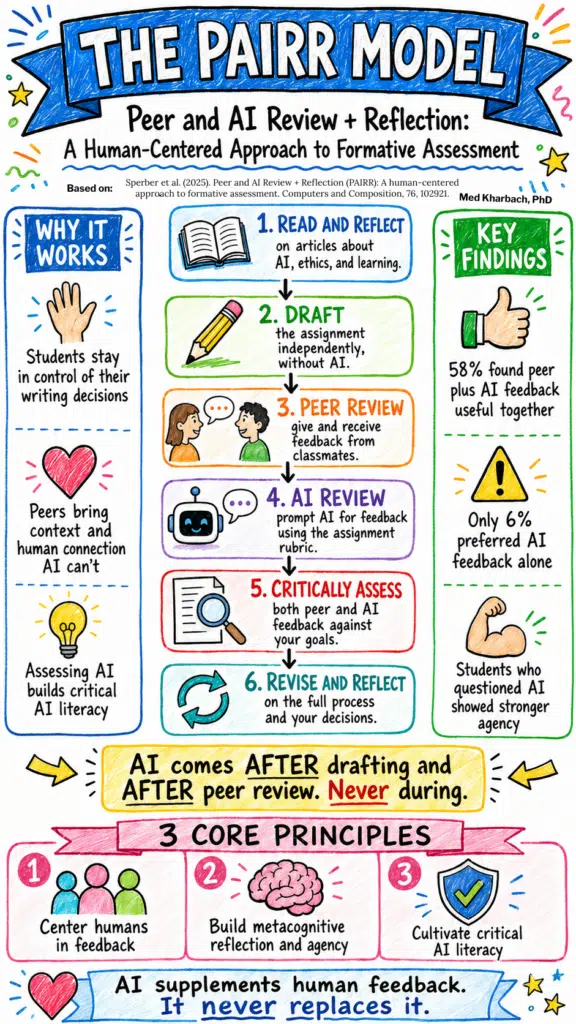
The Six Steps with Sample Activities
Step 1: Read and Reflect
Before any writing happens, students engage with short readings on AI, ethics, and learning. This builds the conceptual foundation they’ll need to evaluate AI feedback later.
Sample activity: Assign a 15-minute “AI ethics warmup” at the start of the writing unit. Students read a short news article about AI in education and answer two questions in a journal entry: “What can AI do well in writing?” and “What can it not do?”
Step 2: Draft Independently
Students write the full first draft without using AI. This step is non-negotiable in the PAIRR model.
Sample activity: Give students 30 minutes of in-class drafting time, devices closed except for the writing platform. For homework drafts, have them submit a screen recording or timestamped draft history showing they wrote the piece themselves.
Step 3: Peer Review
Pair students up and have them give and receive feedback from a classmate.
Sample activity: Provide a structured peer review form with three prompts. “What did this draft do well?” “Where did you get confused?” “What’s one specific revision you’d suggest?” Have students complete it for one peer’s draft in 20 minutes.
Step 4: AI Review
Students prompt AI for feedback using the assignment rubric.
Sample activity: Model a good AI feedback prompt with the class first. Example: “I’m writing an argumentative essay on [topic]. The rubric expects [criteria]. Here’s my draft. Give me feedback specifically on [one rubric category].” Students then run their own prompt and save the response.
Step 5: Critically Assess
Students compare peer feedback, AI feedback, and their own writing goals.
Sample activity: Use a three-column worksheet. Column 1: peer suggestion. Column 2: AI suggestion. Column 3: my decision and why. Students complete one row per piece of feedback they received from either source.
Step 6: Revise and Reflect
Students revise the draft and write a short reflection on the full process.
Sample activity: Submit the revised draft alongside a one-paragraph reflection answering three questions. “Which feedback did you accept and why?” “Which did you reject and why?” “What did you learn about your writing from comparing peer and AI feedback?”
Why the Order Matters
The most important insight from Sperber et al.’s study is what happens when teachers reverse the order. If students get AI feedback before drafting or before peer review, the model breaks. They end up shaping their first draft around what AI suggests, which means AI shapes the thinking when it should only be supporting it.
The sequencing also explains why students in the study preferred peer plus AI feedback together (58%) over AI alone (only 6%). Peer feedback gave them assignment context and emotional support. AI feedback gave them structural suggestions and rubric alignment. Combined, the two complement each other. Alone, neither is enough.
Closing
For teachers wrestling with how to integrate AI into writing instruction without giving up the thinking work, PAIRR is one of the cleanest models out there. The full research is on my academic blog if you want the deeper data and connections to other AI literacy work. The sketchnote above is yours to share.
References
Sperber, L., MacArthur, M., Minnillo, S., Stillman, N., & Whithaus, C. (2025). Peer and AI Review + Reflection (PAIRR): A human-centered approach to formative assessment. Computers and Composition, 76, 102921. https://doi.org/10.1016/j.compcom.2025.102921