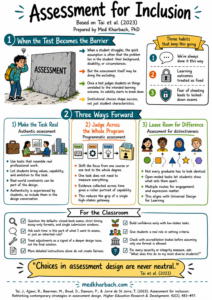
My reading this weekend kept circling one theme: inclusive assessment. Yesterday I wrote about Tai et al.’s (2023) work, and one of their central ideas has shaped how I’m reading everything else. Assessment design is never neutral.
Think about all the quiet decisions baked into a single task. What we ask students to do. How we ask them to do it. Where they complete it. How much time they get. What tools they’re allowed to use. And underneath all of that, what kinds of language, confidence, speed, and prior experience the task silently rewards. Every one of those choices opens a door for some learners and builds a wall for others.
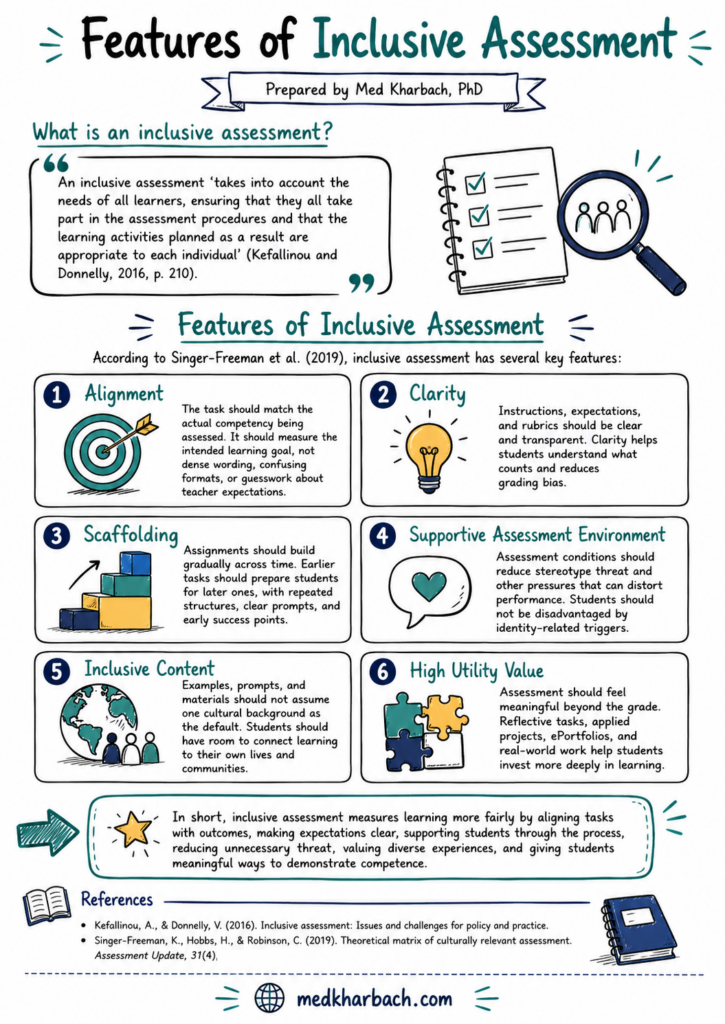
Today I want to make that idea usable in your classroom. I put together a sketchnote on the features of inclusive assessment, drawing on Singer-Freeman et al. (2019), and this post walks through each feature with what it can actually look like when you sit down to design your next task.
What Inclusive Assessment Actually Means
Before the features, a working definition helps. Kefallinou and Donnelly (2016) describe inclusive assessment as practice that “takes into account the needs of all learners, ensuring that they all take part in the assessment procedures and that the learning activities planned as a result are appropriate to each individual” (p. 210). The practical version is simpler. A fair assessment lets every student show what they actually know, without the task itself getting in the way.
The 6 Features of Inclusive Assessment
Singer-Freeman et al. (2019) lay out six features that move an assessment toward fairness. I’ve kept each one short and added a quick picture of what it looks like once it touches a real lesson plan, because a principle only helps when you can act on it.
1. Alignment
The task should measure the competency you actually care about, nothing else. If your goal is scientific reasoning but the question hinges on dense vocabulary or a confusing format, you’re testing reading and decoding, not reasoning. A quick check before you hand anything out: read your own prompt and ask what skill a student really needs to answer it. If the answer isn’t the skill you’re teaching, the task needs a rewrite.
2. Clarity
Instructions, expectations, and rubrics should be transparent. When students have to guess what counts, the confident guessers win and grading bias slips in through the back door. Share the rubric before students start, not after you grade. Show one strong example so the target is visible. Clarity costs you a few minutes upfront and saves everyone the frustration of mismatched expectations.
3. Scaffolding
Skills should build gradually. Earlier tasks prepare students for the harder ones, with repeated structures, clear prompts, and a few early wins along the way. A big end-of-unit project lands very differently when students have already practiced its pieces in low-stakes steps. Break the mountain into hills. Students who might freeze at the full task can climb it one stage at a time.
4. Supportive Assessment Environment
Assessment conditions should lower stereotype threat and the other pressures that distort performance. A student worried about confirming a negative stereotype, or panicking under a ticking clock, isn’t showing you their learning. They’re showing you their stress. Offer practice runs, give students some choice in how they demonstrate mastery, and frame the task calmly. The point is to see their best thinking, not their nerves.
5. Inclusive Content
Examples, prompts, and materials shouldn’t treat one cultural background or life experience as the default. A word problem set entirely in contexts familiar to one group quietly advantages that group. Vary the names, settings, and scenarios. Better yet, give students room to connect the task to their own lives and communities. Relevance isn’t a nice extra. It’s part of what makes the measurement fair.
6. High Utility Value
The task should feel meaningful beyond the grade. Reflective writing, applied projects, ePortfolios, and real-world work give students a reason to invest, and they tend to produce richer evidence of learning as a result. When a student can see why a task matters to their own goals, they bring more of themselves to it. That’s good for engagement and good for the quality of what you get to assess.
Inclusive Assessment in the Age of AI
Are we measuring learning? Or are we also measuring speed, confidence, test-taking culture, language privilege, familiarity with academic norms, and comfort under pressure? Most traditional assessments measure a blend of all of these, and we rarely notice.
That question has gotten sharper as generative AI reshapes how we design tasks. A lot of teachers are reaching for the old playbook to AI-proof their assessments: timed, in-person, handwritten, no devices. I understand the instinct. But that move can disadvantage students with disabilities, multilingual learners, and anyone who struggles under a clock. We’d be solving one problem and rebuilding an older form of exclusion in its place. The six features above are a good filter to run any AI-era redesign through before you commit to it.
References
- Kefallinou, A., & Donnelly, V. (2016). Inclusive assessment: Issues and challenges for policy and practice.
- Singer-Freeman, K., Hobbs, H., & Robinson, C. (2019). Theoretical matrix of culturally relevant assessment. Assessment Update, 31(4).https://doi.org/10.1002/au.30176
- Tai, J., Ajjawi, R., Bearman, M., Boud, D., Dawson, P., & Jorre de St Jorre, T. (2023). Assessment for inclusion: Rethinking contemporary strategies in assessment design. Higher Education Research & Development, 42(2), 483–497. https://doi.org/10.1080/07294360.2022.2057451