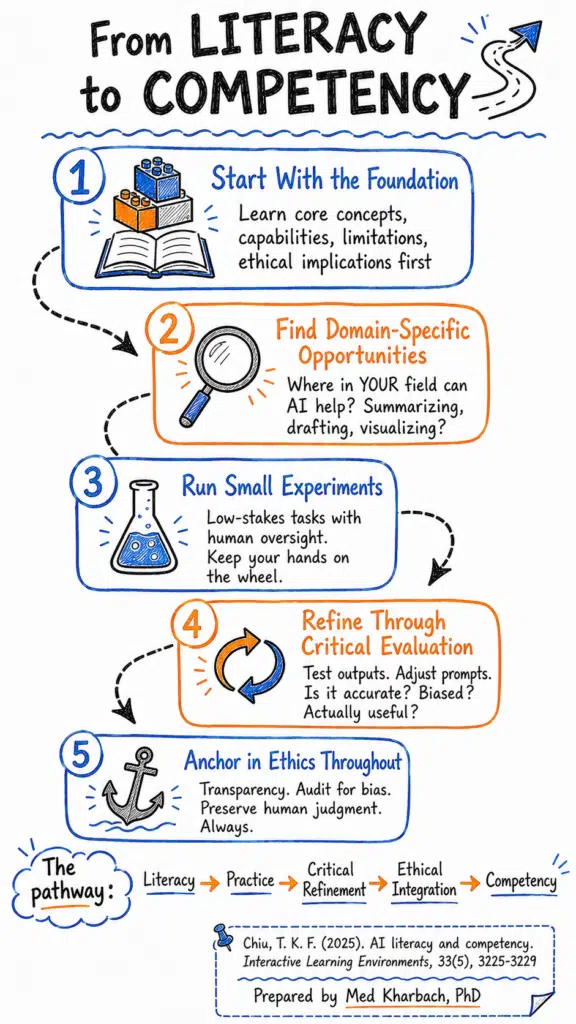
I’m revisiting Chiu’s (2025) paper on AI literacy and competency, a piece I covered before in a previous post. This time I put together a sketchnote with help from Claude, ChatGPT, and Canva to make the key ideas easier to share. The visual helped me see what makes the paper useful: it draws a clear line between two terms that have been getting muddled together in the AI in education conversation.
The field has a terminological problem. AI literacy, AI competency, AI fluency, AI readiness. These get tossed around interchangeably, and that creates real confusion for educators building curricula, writing policies, or designing professional development. Chiu’s paper does the conceptual work of separating these out and giving each its own job description.
AI Literacy Is About Understanding
Chiu defines AI literacy as the knowledge, critical thinking, and ethical awareness needed to make sense of AI. It serves as the foundation. It asks the question, “What does this AI do?” Why does it produce the output it produces? What are the limits? What’s at stake when we use it?
AI literacy doesn’t require coding. It doesn’t require building anything. It requires the ability to evaluate AI critically, recognize biases in AI systems, and understand their broader social implications. Chiu treats it as the floor everyone needs. Students, teachers, policy makers, journalists, citizens all begin from the same place.
Hillman, Holmes, and Duarte (2025) reach a similar conclusion in their Royal Society rapid review of AI literacy frameworks: conceptual understanding has to come first, with technical fluency built on top of it.
AI Competency Is About Action
If literacy is the compass, competency is the engine. Chiu defines AI competency as the practical proficiency to use, manage, and even develop AI in real-world contexts. It asks the question, “How do I make this work better?”
Competency is built on top of literacy. You can’t get to good AI use without first understanding what AI is and how it operates. Chee, Ahn, and Lee (2025) describe a similar progression in their AI literacy competency framework, where the path from awareness to skilled use is staged through specific cognitive moves.
The split helps explain why some recent policy debates feel stuck. A district leader calling for “AI literacy” in schools may have very different things in mind than a teacher trying to “build AI competency” in their students. Chiu’s framing gives us a vocabulary to clarify what we actually mean before we design programs around it.
Ten Literacies That Feed AI Literacy
The most useful move in Chiu’s paper, for my reading, is the argument that AI literacy isn’t a self-contained skill. He lists ten other literacies that feed into it: mathematical, data, ethical, media, computational, linguistic, visual, domain-specific, scientific, and design.
These aren’t optional extras. Gaps in any one of them create blind spots in how we understand and use AI. A teacher with weak data literacy will struggle to evaluate AI-generated statistics. A student lacking ethical literacy may miss the moral weight of an automated decision. Researchers with thin media literacy run into trouble assessing AI-generated text in social media contexts.
Chiu’s point is that AI literacy lives at an intersection. It develops gradually across courses, drawing on the broader literacies a learner has already built up over their education.
What This Means for Educators
The practical implication is that AI literacy programs need to think holistically. An AI literacy course built in isolation, without grounding in the broader literacies it depends on, will produce thin learners who can repeat AI vocabulary without the judgment to apply it. Sidra and Mason (2026) make a related case in their work on collaborative AI literacy and metacognition.
If you’re designing AI literacy curriculum for your school or district, Chiu’s paper is a useful starting point. The conceptual clarity it offers, paired with the realistic acknowledgment that AI literacy depends on a wide set of other skills, makes it one of the better entry points I’ve seen in this conversation.
The sketchnote below pulls the key ideas together into a shareable visual.
Reference
Chiu, T. K. (2025). AI literacy and competency: definitions, frameworks, development and future research directions. Interactive Learning Environments, 33(5), 3225-3229.