If you’ve been reading Educators Technology for a while, you know I’ve been writing about AI in the classroom for a few years now, both here and on my academic blog at medkharbach.com.
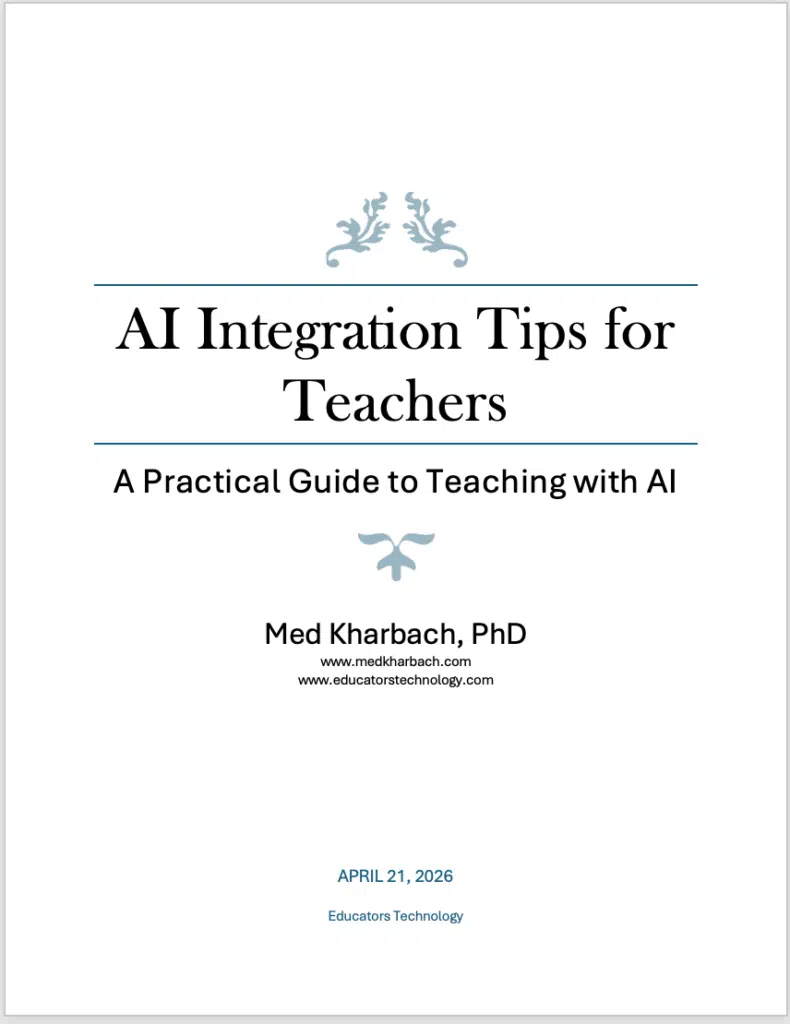
I get a lot of questions from teachers about how to actually start integrating AI in their classroom in a way that works, not just adding tools because they’re trendy. So I put together a free guide called AI Integration Tips for Teachers that pulls together what I’ve learned from years of teaching with AI, writing about edtech, and reading the research.
This post is a quick walkthrough of what’s inside the guide and where to grab the free PDF.
What’s Inside the Guide
The guide is built on one simple idea: pedagogy comes first, AI second. Tools change every six months. The pedagogical questions don’t change with them. McTighe and Wiggins’ Understanding by Design framework still works in 2026, and the guide uses that backward design logic throughout. You start with what you want students to learn, then figure out how you’ll know they’ve learned it, and only then bring in AI as one option among many.
The guide is organized into four practical sections.
1. Develop Your AI Pedagogy
The first section walks you through how to build an intentional, goal-driven approach to AI integration. It includes a self-assessment rubric with five core dimensions: learning goals clarity, backward design alignment, intentional AI role, student agency, and reflective practice. You can use the rubric to figure out where you are now and identify where you want to grow.
2. Co-build a Classroom AI Agreement
The second section covers something I’ve been doing in my own classes for a while: building the AI rules together with my students. I prefer the word “agreement” over “policy” because it changes the dynamic. Students who help shape the rules follow them more often, and they understand why those rules exist.
This section includes a ready-to-use template covering eight areas, from why you’re using AI in the class to what happens when something goes wrong. Each area comes with discussion questions you can use to guide the conversation with your students.
3. Rethink Your Assessments for the AI Era
This is where AI has caused the most disruption, and it’s where teachers most need a clear approach. I lean on Corbin et al.’s (2025) framing of the “wicked problem” of AI and assessment. The section covers why “AI-proof” assignments are a fantasy, why “AI-resistant” framing leads to an arms race, and what to do about both.
The practical advice is concrete: connect assessments to personal experience, focus on transfer, make assignments incremental and process-based, include oral or live components, and require students to evaluate AI outputs themselves. The section also includes a table of design questions you can use to pressure-test any assignment before you give it.
4. Evaluate Your AI Tools Before You Use Them
The number of AI tools marketed to teachers grows every week, and most of them won’t be in your classroom a year from now. The final section gives you an evaluation rubric drawn from frameworks by UNESCO, OECD, aiEDU, and ISTE. Eight dimensions to consider before adopting any tool: ease of use, educational value, effectiveness, data privacy and security, ethical standards, accessibility, cost-effectiveness, and customization.
Use it as a pre-flight checklist before you commit to any new tool.
Why This Guide
I’ve reviewed a lot of guides, frameworks, and recommendations over the years. Most of them treat AI integration as a technical question, when it’s actually a pedagogical one. The teachers I’ve seen get real results with AI are the ones who started with what they wanted to teach, not with which tool was trending on social media.
The guide is short, practical, and free. Every section gives you something you can pick up and use right away: a rubric, a template, a table of questions. I wanted it to be the kind of resource you return to when you’re planning a unit, rethinking an assignment, or weighing a new tool.
Download the Free PDF
The full guide is available as a free PDF. You can download it from my blog and share it with colleagues. The license is Creative Commons (Attribution-NonCommercial-ShareAlike 4.0), so you’re free to share it, adapt it, and build on it for your own teaching context, just give appropriate credit.