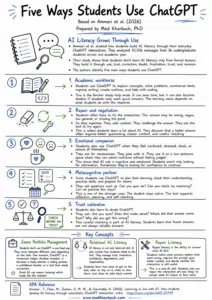
AI literacy often gets reduced to tool use. In classrooms, what matters far more is how students think with AI, how they position it in their learning process, and how they remain intellectually responsible for the work they submit. In my work with students and educators, I see AI-literate students sharing a common set of practices. These practices show up across disciplines and levels.
Here is how AI-literate students engage with AI in meaningful and productive ways.
1. They use AI as a thinking partner
AI-literate students treat AI as a conversational partner that responds to thinking that already exists. They begin by laying out their own understanding of a topic or problem in their own words. Only then do they bring AI into the process.
They ask AI to restate their reasoning, comment on its coherence, surface weak links, challenge assumptions, or offer alternative perspectives. AI becomes a dialogic peer that pushes thinking forward. This back-and-forth helps students make their learning visible and creates space for revision, judgment, and growth.
2. They use AI to edit the mechanics of language
Language demands can crowd out thinking. AI-literate students manage this by separating ideas from wording. They write freely in early drafts, focusing on meaning rather than polish. This shift frees up cognitive resources for ideation and reasoning.
Once ideas feel solid, students bring AI in to proofread and edit small sections. They ask for help with grammar, clarity, and flow while keeping meaning and structure intact. Language improves, voice stays theirs, and coherence remains under student control.
For the full PDF guide, check out this link!
3. They ideate themselves
AI-literate students take ownership of ideation. Ideas grow from readings, discussions, and lived experience. Students write these ideas down before involving AI.
At that point, AI supports refinement. It offers feedback, suggests alternative directions, or points to gaps worth exploring. The core thinking remains original. This approach protects authenticity and prevents the convergence that occurs when everyone asks AI to generate ideas on the same topic.
4. They question and verify AI information
AI-literate students approach AI output with scrutiny. They understand that hallucinations, bias, and fabricated citations appear frequently in AI responses.
They check statistics, facts, quotations, page numbers, DOIs, and references against reliable sources. Verification becomes a routine academic habit rather than an extra step. Responsibility for accuracy remains with the student.
5. They maintain intellectual ownership
AI-literate students engage actively with their work from start to finish. They draft, revise, and submit work that reflects their own understanding and judgment.
This approach supports learning goals that extend beyond grades. Students develop habits of inquiry, critical evaluation, and thoughtful decision-making that carry into civic and professional life.
6. They use AI to enhance reading comprehension
AI offers powerful support for reading when used at the right moment. AI-literate students complete an initial reading themselves. After that, AI helps clarify dense passages, explain difficult concepts, generate analogies, or translate ideas into familiar language.
Because students already understand the text at a basic level, they can catch errors, notice drift, and assess the quality of AI explanations. AI deepens comprehension and supports synthesis after engagement with the text.
Some students also use contained-context tools such as NotebookLM to interrogate readings, request specific quotations, and explore connections across texts, always verifying outputs against original sources.
7. They use AI for formative feedback
AI-literate students use AI as an always-available feedback partner. They ask for critique on ideas, outlines, drafts, and plans. They assign roles such as peer reviewer or skeptical reader and invite direct feedback.
Students then decide what to accept, revise, or reject. This decision-making process strengthens judgment. In class, these moments create opportunities to discuss feedback quality, alignment with criteria, and reasoning behind revisions.
8. They set clear boundaries for AI use
AI-literate students make deliberate choices about when AI supports learning and when independent thinking takes priority. They understand that different tasks call for different levels of AI involvement.
Teachers can support this by designing hybrid assessments, some AI-enabled and others intentionally independent. Clear boundaries help students use AI with purpose rather than habit.
9. They reflect on how AI shapes their thinking
Reflection anchors AI literacy. AI-literate students pause to consider how AI influences their ideas, decisions, and learning strategies. They document when they use AI, for what purpose, and with what effect.
This reflective stance strengthens metacognition. Students begin to anticipate how tools might shape their thinking and adjust strategies proactively. Over time, this leads to more intentional learning and more responsible AI use.

Closing thoughts
AI literacy lives in practice. It shows up in how students think, write, read, question, and reflect. When AI use stays grounded in judgment, ownership, and reflection, it supports and improves learning. The goal remains the same as it has always been: helping students develop habits of thinking that last well beyond the classroom.